Virginia Home Grown
Peanut Farming
Clip: Season 26 Episode 6 | 8m 18sVideo has Closed Captions
Meet a fourth-generation farmer that practices a traditional sun drying process to cure peanuts
Randy Battle visits Elisha Barnes of Pop Son Farm in Franklin to learn about traditional methods for growing and curing peanuts. Featured on VHG episode 2606, August 2026.
Problems playing video? | Closed Captioning Feedback
Problems playing video? | Closed Captioning Feedback
Virginia Home Grown is a local public television program presented by VPM
Virginia Home Grown
Peanut Farming
Clip: Season 26 Episode 6 | 8m 18sVideo has Closed Captions
Randy Battle visits Elisha Barnes of Pop Son Farm in Franklin to learn about traditional methods for growing and curing peanuts. Featured on VHG episode 2606, August 2026.
Problems playing video? | Closed Captioning Feedback
Where to Watch Virginia Home Grown
Virginia Home Grown is available to stream on pbs.org and the PBS app.
Providing Support for PBS.org
Learn Moreabout PBS online sponsorship>>I'm a fourth generation farmer.
My father, his father, his father, all farmed the land.
I was that one child that loved playing in this dirt.
>>Your soil is nice and tilled.
Is it sandy?
>>This is called sandy loam.
This area's soil is called sandy loam.
It is perfect for the raising of peanuts because of the sandiness allows the excess water to drain out, but the sandiness also allows the peanut pegs to penetrate, go into the ground and make a wonderful crop.
The good thing about peanuts is they love hot, humid weather.
>>We've had a lot of that.
>>And we've had a lot of that.
>>Yeah, so this crop looks amazing.
What do we call this?
>>Is it a stalk?
>>It is a peanut plant.
>>Okay.
>>It is actually a legume.
It grows its nut inside of a shell.
The farmer who farms a peanut has to be the most trusting of any farmer.
Because the peanut doesn't show you that it's doing anything until you dig it up.
>>Because it's underground.
>>It's underground.
>>So if you don't mind showing us where you're at right now with the peanut plant.
I know they're not ready yet, but at least we can see maybe a little something.
>>So if you will, we'll look down here.
>>Uh-huh.
>>And we have this peanut plant.
And we're going to try to pull it up so that we can get all that is already on the vine.
>>Okay.
Oh, wow.
>>Now, when we look under here, all of these little nodules here are going to be peanuts.
>>Okay.
>>We still have about six to eight weeks of growing time.
>>Okay.
>>These larger ones that you see here came on in the first to mid of July.
So that's about a month worth of growing right there.
>>Okay.
>>In another month, all of these will be peanuts this size.
So we've got harvest expectations somewhere around the last of September, maybe the 1st of October.
But we'll come out and we'll check the ripeness of each one and throughout the field to get an idea of when it would be the best time to dig them up.
>>Do you use a tractor or?
>>Yes.
I have a two row digger.
>>Uh-huh.
>>That digs two rows up at a time and it drops them right back down because in the shocking process, you don't want them turned up.
You want them turned down because you're going to place them on the pole with the nuts down and to the inside of the pole.
>>Now tell us a little bit about that shocking.
>>That's the shocking process.
>>Okay.
>>What we are doing then, we're putting them on those poles so that they can sit there for six weeks as they dry and cure.
>>Okay.
>>And one of the keys is to make sure that when you put them on the pole, that the nuts are hanging down and pointed to the inside of the pole.
>>Wow.
>>That way as it rains, the rain does not affect the nut as it's cured.
Because all of the water will take the path of least resistance around the outside of the shock, leaving the inside of the shock dry for the curing.
>>Now I understand that you are one of the only people doing this process.
Tell us about that.
How did you become the only one?
>>I'm actually the only person that I know of that's still doing these old antiquated ways because it is labor intensive, it is slow, and the volume or quantity is limited with what I do.
Other peanut farmers have adopted a modern technique, which is to harvest their crop and then dry them artificially.
>>Okay.
>>It only takes about 24 hours and they can dry them and put them on the market.
Where mine stay on the pole for six weeks.
That's what allows them to be so sweet and the quality.
>>As I grow my crops, I'm just a small backyard farmer.
But like you said, it's not about the quantity, but the quality.
And I feel great eating things out of my backyard garden because I know what I put into it.
>>And that should be the industry standard for us to know and put into what we're eating because we become a product of what we eat.
My thing is, I like to take it back to the bare basics so that I only put in what is needed.
>>Right.
>>I only treat what I see.
I don't preemptively strike on something.
I wait and see what comes up and then I address that need.
That cuts down on quantity, but it increases the quality.
>>And that's a good point that you just made.
You see the issue come up and then treat.
A lot of people start spraying different pesticides and different chemicals on their plants before they even see an issue.
And that can be a problem.
>>It can be a problem.
And that's why you see that my fields are not as, I guess you would call it clean as other fields, but because I wait until I see a problem and then I begin to address it.
>>And I understand that you do a lot of this by yourself.
>>Most of what I do, I do by myself because there are not many people who are willing to invest the time, the labor to come out here and do this because it is manual labor.
But the thing that I say to everyone is, if you don't have a passion for it, it's not something you're going to get into.
Because this is not about the volume of production, but the quality.
>>The quality.
>>Of what you produce.
>>Yes.
>>A peanut that no one else raises like I do.
My granddaughter is the one who wants to be a farmer.
She's been out here with me.
She plants crop with me.
She discs on the tractor with me.
She pull weeds.
We're trying to preserve the history because this becomes a part of you.
>>Right.
>>It is not something that you do for work.
This is something you do for love.
I have my family, my mother, my father, those that are in my community to thank for laying the foundation for where I stand on now.
>>And I understand you have a few sponsors and you guys give back to the food banks and things like that.
And you also have a partnership with the peanut company and it's going well for you.
Tell us a little bit about that.
>>It really has.
One of the things that has been my blessing is to have the partnerships with the food bank, with Hubs, with AMADAS Industries, with Peachtree Farms, myself, and we've just acquired new sponsorship by Willie Nelson and the Farm Aid.
They have come on board.
So what it does, it allows us to be able to give back to the community.
The corn that you see off in the distance.
We raise that corn and we give it to the food bank, and the food bank then distributes it to needy families all across the Eastern Shore and Southeastern Virginia.
So it is a way of being able to really help those that are struggling.
My father used to say it this way.
"Son, if you can raise enough to have some to give away, you'll always have enough for yourself."
And I live by that creed.
>>Thank you so much for that advice.
I will live by it as well.
And we thank you so much for having us here today.
We appreciate you.
>>Thank you.
>>And you keep on growing.
>>I will continue to play in the dirt.
>>That's right.
Play in the dirt.
>>That's it.
Video has Closed Captions
Clip: S26 Ep6 | 3m 12s | Increase your blackberry harvest with proper pruning techniques (3m 12s)
Video has Closed Captions
Clip: S26 Ep6 | 8m 14s | Learn about tobacco cultivated by indigenous peoples to use for ceremonial purposes (8m 14s)
Video has Closed Captions
Clip: S26 Ep6 | 3m 16s | Brighten up your garden with sunflowers (3m 16s)
Video has Closed Captions
Clip: S26 Ep6 | 4m 31s | Learn how transplant lettuce and kale into your garden (4m 31s)
Video has Closed Captions
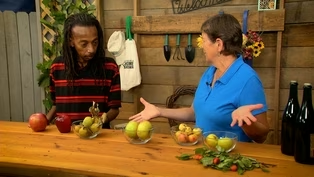
Clip: S26 Ep6 | 5m 4s | Discover Virginia’s role in shaping popular apple varieties (5m 4s)
Providing Support for PBS.org
Learn Moreabout PBS online sponsorship

- Home and How To

Hit the road in a classic car for a tour through Great Britain with two antiques experts.
 New Season





 New Episode
 New Episode


Support for PBS provided by:
Virginia Home Grown is a local public television program presented by VPM