Virginia Home Grown
Growing Sunflowers
Clip: Season 26 Episode 6 | 3m 16sVideo has Closed Captions
Brighten up your garden with sunflowers
Amyrose Foll shows off the many sunflower varieties that she grows while explaining their wide range of uses. Featured on VHG episode 2606, August 2026.
Problems playing video? | Closed Captioning Feedback
Problems playing video? | Closed Captioning Feedback
Virginia Home Grown is a local public television program presented by VPM
Virginia Home Grown
Growing Sunflowers
Clip: Season 26 Episode 6 | 3m 16sVideo has Closed Captions
Amyrose Foll shows off the many sunflower varieties that she grows while explaining their wide range of uses. Featured on VHG episode 2606, August 2026.
Problems playing video? | Closed Captioning Feedback
Where to Watch Virginia Home Grown
Virginia Home Grown is available to stream on pbs.org and the PBS app.
Providing Support for PBS.org
Learn Moreabout PBS online sponsorship(fast clicking) >>Today we're talking about sunflowers.
They are an iconic American beauty.
They're native to this continent, and they're actually grown on every continent on earth now.
These here, this is a Hopi Dye sunflower.
There's many different varieties, and you'll see many different varieties around the farm today between bright orange to a pale lemon chiffon yellow and everything in between.
Different sizes, different shapes, different ways of growing.
They've got many different forms and habits from bushy sunflowers like this to very tall uprights.
They're an excellent plant to use in your garden if you're going to have kind of a wild flower garden with different stories to it.
Because they'll give you height and then you can bring in your medium and your ground cover plants below it.
It makes for a beautiful landscape.
They're excellent for birds and bees.
If you're a birder, they will bring a bouquet of color to your backyard.
So you really get a great view of that wildlife.
And they're excellent for our bees, including mason bees that are native to Virginia.
There are actually native Virginian sunflowers.
They're called Sunchokes, and they are a perennial sunflower, and they put out very delicious tubers that you can bring up from the ground in the fall.
And they're very high in fiber and natural insulin, so they're a very healthy food.
We've got many different kinds of sunflowers.
This guy right here, he is a Russian Mammoth, which the name kind of is a misnomer.
Russian Mammoths are originally from the United States.
And these guys are great, because if you're going to get into seed saving, this is an excellent plant to start with.
It's not intimidating, there's no special process to it.
And basically all you do is cut it down when they're about this size, and you're going to cut it as close to this as possible.
You can remove some of this extra tissue, so that you can fight possible fungus if it's a little bit rainy when you're drying them out.
You want to make sure they're very dry, because the fungus can affect the germination rate of your plants.
And peel all this extra stuff back, and see how easy they come out.
They're excellent and so easy to do.
And you can make little gifts for your gardening friends for next year or for those people that have everything, to package up and give away your own seeds.
And the wonderful thing about that is you can cross-pollinate different sunflowers to create your own varieties in different colors and sizes and really play with them.
They're very easy to work with from season to season.
And it's such a simple process.
There's nothing that needs to be done, no special equipment.
Sunflowers are just absolutely fascinating plants.
They play a major role in our agricultural economy from everything from animal feed, sunflower oil, to sunflower seeds that you get as a treat.
And sunflower nutmeats can be made into a flour to be used in baking, which is a great alternative for people that have celiac disease.
It's just a little bit hard to find.
Sunflowers are such an easy addition to your garden.
As long as they have some sun, they require very little care to grow.
And they really are a jewel in the garden, and you can't help but smile when you look at them.
So if you haven't put them in your garden in previous seasons, I definitely suggest picking up a few packages at your local nursery supply company and try them out.
They are fantastic plants.
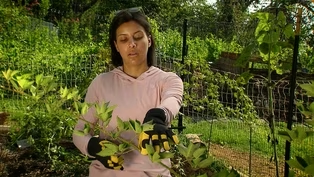
Video has Closed Captions
Clip: S26 Ep6 | 3m 12s | Increase your blackberry harvest with proper pruning techniques (3m 12s)
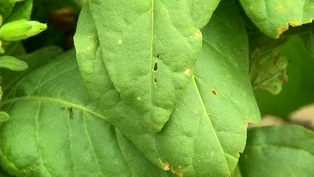
Video has Closed Captions
Clip: S26 Ep6 | 8m 14s | Learn about tobacco cultivated by indigenous peoples to use for ceremonial purposes (8m 14s)
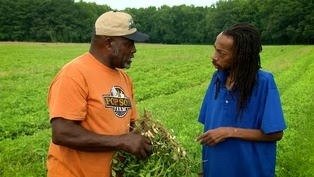
Video has Closed Captions
Clip: S26 Ep6 | 8m 18s | Meet a fourth-generation farmer that practices a traditional sun drying process to cure peanuts (8m 18s)
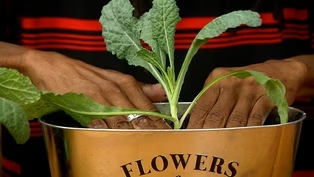
Video has Closed Captions
Clip: S26 Ep6 | 4m 31s | Learn how transplant lettuce and kale into your garden (4m 31s)
Video has Closed Captions
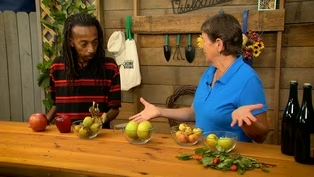
Clip: S26 Ep6 | 5m 4s | Discover Virginia’s role in shaping popular apple varieties (5m 4s)
Providing Support for PBS.org
Learn Moreabout PBS online sponsorship

- Home and How To

Hit the road in a classic car for a tour through Great Britain with two antiques experts.
 New Season





 New Episode
 New Episode


Support for PBS provided by:
Virginia Home Grown is a local public television program presented by VPM