Virginia Home Grown
Blackberry Care
Clip: Season 26 Episode 6 | 3m 12sVideo has Closed Captions
Increase your blackberry harvest with proper pruning techniques
Chris Martin explains the importance of knowing the difference between floricanes and primocanes for pruning blackberry plants to produce a more abundant harvest. Featured on VHG episode 2606, August 2026.
Problems playing video? | Closed Captioning Feedback
Problems playing video? | Closed Captioning Feedback
Virginia Home Grown is a local public television program presented by VPM
Virginia Home Grown
Blackberry Care
Clip: Season 26 Episode 6 | 3m 12sVideo has Closed Captions
Chris Martin explains the importance of knowing the difference between floricanes and primocanes for pruning blackberry plants to produce a more abundant harvest. Featured on VHG episode 2606, August 2026.
Problems playing video? | Closed Captioning Feedback
Where to Watch Virginia Home Grown
Virginia Home Grown is available to stream on pbs.org and the PBS app.
Providing Support for PBS.org
Learn Moreabout PBS online sponsorship(lively percussive music) >>Today, we're here, pruning blackberries in my upper garden bed.
This time of year is a perfect time to be pruning your blackberries, late summer, early fall, where you're able to see a lot of that big growth from your first-year primocanes, and also able to tell which of your second-year floricanes are ready to be trimmed to the ground.
Blackberries, I love to use in jams, jellies, sauces, fillings, as well as being able to garnish cakes, carefully choosing which leaves and, like, berry stems to choose because this one is a thorn variety.
There are thornless varieties, but the green pop on cakes as well as the fresh berries.
With the jam on the inside, it's my go-to.
I love being able to incorporate that fresh component on top and then the cooked stable component on the inside.
But I digress.
The blackberries here we planted last year, so we don't have any trellising for them.
I wanted to make sure that they were going to be successful this year.
The primocane, you're able to tell that it is your first-year growth because there are five leaves.
Here, since I'm a little bit shorter, you can trim them and prune them between three and four feet in height.
So, I'm five feet.
Three feet is gonna be about here.
And when you make this cut right here, you'll be encouraging lateral growth, which means sideways growth, which is the growth that you'd want to trellis and give some support.
I'm gonna go right about here.
(stem crunches) These branches, you can just discard, use as mulch, or put in your compost.
If you find that your bushes are battling some disease, you'll wanna burn this.
But in this case, we're good to go.
I'm going to use it just as a mulch at the base here.
And you'll find since that was a thorny bush, wearing gloves is really gonna help me to be protected during this process.
You'll also want to prune your second-year growth, the floricanes.
These ones, you'll be able to tell by the fact that they have three leaves, one, two, three, as well as some dried vegetation.
At the top right here is a flower structure.
But there'll be dried evidence and brown evidence of berries and flowers from the previous growing season.
If you have taller secondary canes than I do, since this was the first-year planting, these are much closer to the ground, you want to get your second-year floricane growth.
Find it and trail it all the way to the base of the plant, and that's where you're going to prune.
These will not grow berries again, and they won't serve a purpose besides being really great mulch at the base of your plant.
Returning nutrients back to the ground.
If you don't have berry plants already started in your gardens, now is a great time to start.
They grow really quickly, they establish really fast, and they spread really well, so you also wanna make sure that you're planting them in an area where you can easily access and prune them over time.
I wanted to make sure here that I'd be able to mow on one side because they'll throw up runners in places you never expect.
So, ultimately, make sure you have a lot of space around your plant to be able to access and prune, as well as provide the trellising that they need.
Good luck and happy gardening.
Video has Closed Captions
Clip: S26 Ep6 | 8m 14s | Learn about tobacco cultivated by indigenous peoples to use for ceremonial purposes (8m 14s)
Video has Closed Captions
Clip: S26 Ep6 | 3m 16s | Brighten up your garden with sunflowers (3m 16s)
Video has Closed Captions
Clip: S26 Ep6 | 8m 18s | Meet a fourth-generation farmer that practices a traditional sun drying process to cure peanuts (8m 18s)
Video has Closed Captions
Clip: S26 Ep6 | 4m 31s | Learn how transplant lettuce and kale into your garden (4m 31s)
Video has Closed Captions
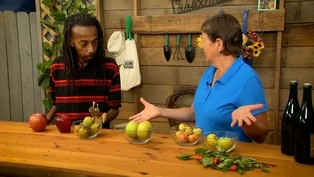
Clip: S26 Ep6 | 5m 4s | Discover Virginia’s role in shaping popular apple varieties (5m 4s)
Providing Support for PBS.org
Learn Moreabout PBS online sponsorship

- Home and How To

Hit the road in a classic car for a tour through Great Britain with two antiques experts.
 New Season





 New Episode
 New Episode


Support for PBS provided by:
Virginia Home Grown is a local public television program presented by VPM