
Takeaways from the Florida and Alaska primaries
Clip: 8/19/2026 | 7m 46sVideo has Closed Captions
What the Florida and Alaska primary results mean for November
An upset win by a progressive candidate leads a host of headlines from Tuesday's primaries. In the Senate primary, Florida state Rep. Angie Nixon trounced more moderate Democrat Alex Vindman, even though he spent far more money. In Alaska, Democrat Mary Peltola was the top vote-getter in the non-partisan Senate primary. Lisa Desjardins reports.
Problems playing video? | Closed Captioning Feedback
Problems playing video? | Closed Captioning Feedback
Major corporate funding for the PBS News Hour is provided by BDO, BNSF, Consumer Cellular, American Cruise Lines, and Raymond James. Funding for the PBS NewsHour Weekend is provided by...
Takeaways from the Florida and Alaska primaries
Clip: 8/19/2026 | 7m 46sVideo has Closed Captions
An upset win by a progressive candidate leads a host of headlines from Tuesday's primaries. In the Senate primary, Florida state Rep. Angie Nixon trounced more moderate Democrat Alex Vindman, even though he spent far more money. In Alaska, Democrat Mary Peltola was the top vote-getter in the non-partisan Senate primary. Lisa Desjardins reports.
Problems playing video? | Closed Captioning Feedback
Where to Watch PBS News Hour
PBS News Hour is available to stream on pbs.org and the PBS app.
Providing Support for PBS.org
Learn Moreabout PBS online sponsorshipAMNA NAWAZ: Welcome to the "News Hour."
An upset win by a progressive candidate in Florida leads a host of headlines from yesterday's primary elections.
GEOFF BENNETT: Florida State Rep.
Angie Nixon, a member of the Democratic Socialists of America, beat moderate Democrat Alex Vindman, even though he had a major spending advantage.
Nixon said the race challenges the way the right has sought to define progressives.
ANGIE NIXON (D), Florida Senatorial Candidate: They look at this movement and they call us extreme.
They call us radical.
But I think people see through that.
I won't let them define me.
And I know you will always know where I stand, with you everyday people, everyday hardworking people.
(CHEERING) GEOFF BENNETT: In Alaska, another key race, moderate Democrat Mary Peltola, is the top vote-getter in the nonpartisan U.S.
Senate primary.
She and incumbent Senator Dan Sullivan, a Republican, move on to the November ballot.
Our Lisa Desjardins is here to talk us through what happened yesterday.
OK, Lisa, so let's start with the surprise of the night, a big progressive win in Florida.
Bring us up to speed.
LISA DESJARDINS: That Senate primary victory was a surprise to most, but not to the candidate herself.
She is Angie Nixon, a member of the Florida House of Representatives.
She's known for pink, including a pink megaphone.
She did just join the DSA, Democratic Socialists of America.
But she stresses that she has a unique and important coalition of the young, the suburbs and cities.
She easily defeated Alex Vindman.
Some viewers may recognize him as the key witness in the first impeachment of President Trump.
He outraised Nixon 16 to 1.
But look at where Nixon did well.
If you look at the map of the results of Florida, you can see it was really all over the state, not just in cities and urban centers, but in rural parts.
And when we talked to Kimberly Leonard, who writes the Florida Playbook for Politico, she said Nixon was a tireless campaigner.
KIMBERLY LEONARD, Politico: She's not a polished politician, and she's someone who's more of a grassroots organizer.
I mean, when she walks into a room and gets on stage, people are on their feet, they're clapping, they're jumping.
She is just really magnetic.
And I think that that was a big difference that ended up carrying her over.
LISA DESJARDINS: A progressive member of Congress who obviously liked to see that win said you can't take too much away from it.
But one of that person's takeaways was that maybe there are still doubts about polling overall this election cycle.
GEOFF BENNETT: Meantime, Florida's Republicans remapped the state.
How did the incumbents do in their new districts last night?
LISA DESJARDINS: The Democratic incumbents who were targeted did well.
Let's look at two big names specifically.
That's Democrats Debbie Wasserman Schultz and Jared Moskowitz.
Each of them prevailed in their primaries in new remapped districts.
Wasserman Schultz especially got some attention because she was running in what is now a plurality Black district.
She ran against four African American challengers.
Some say they split the vote of the Black community.
Of course, Wasserman Schultz herself is a well-known incumbent.
She has a long record in Florida as well.
She moves on to November.
There was one incumbent in Florida who did lose, and it was a Republican.
I'm talking about Representative Cory Mills.
He's in the midst of multiple investigations.
You see there he fell short.
He is alleged -- there are abuse allegations, assault allegations, also accusations that he profited off his office.
He denies all wrongdoing, but now, because of that result, he will not be returning to Congress in January.
President Trump endorsed Cory Mills, but today he tried to frost that over.
He wrote on TRUTH Social: "I told Congressman Cory Mills of Florida, a friend of mine, to get out of the race, but he wouldn't listen."
Trump has now endorsed the person who beat Cory Mills last night.
GEOFF BENNETT: And another person endorsed by the president did win big in Florida.
Tell us about the Florida governor's race.
LISA DESJARDINS: That's right.
This is a current congressman with also a very large profile.
Talking about here Byron Donalds, who now represents Fort Myers on the Gulf Coast.
He's been known for his ambition in Congress.
Last night, he easily beat all of his competitors to get the Republican nomination in the race to replace Ron DeSantis.
He will face Democrat David Jolly.
He's a former congressman also.
Now, given Florida's recent history, it looks like Donalds has the advantage here.
But it's also interesting that his win last night was part of an important theme.
We have seen in primaries now we have seven Black nominees for governor, some Democrats, some Republicans.
In states from Florida to Wisconsin to Nevada, in all of U.S.
history to date, there have only been just three Black Americans elected to governors in a state.
And now we have seven on the ballot in November.
GEOFF BENNETT: Well, from Florida to Alaska, what happened there?
LISA DESJARDINS: Yes.
Let's go all over.
It's the other corner of the country.
Democrats had a good night in Alaska, but they still have some tough races in November.
Let's start with the U.S.
Senate.
That's where former Alaska Congresswoman Mary Peltola was the lead vote-getter.
She's a key hope of Democrats who want to reclaim the Senate.
She's challenging the incumbent Republican senator.
There he is, Dan Sullivan.
Now, we talked about this race because it's a toss-up with a twist.
There is a second Dan Sullivan also on the ballot.
We spoke with Eric Stone of Alaska Public Media.
He said it will be an intense and expensive race.
ERIC STONE, Alaska Public Media: Mary Peltola has a has a very high statewide profile.
She's very well-known in the state.
And Senator Sullivan does too.
This is a typically Republican-leaning state, and that sort of gives him a little bit of built-in advantage.
Both are going to have a hard time beating each other in -- as we get towards the general election.
LISA DESJARDINS: As of right now, the other Dan Sullivan will be on the ballot, but he got just a small percentage last night.
GEOFF BENNETT: And in the time that remains, let's talk about South Carolina, because Republicans will pick the candidate to replace the late Senator Lindsey Graham next week.
And last night was the first and only debate for his sister, the sitting Senator Darline Graham, and her primary opponent.
It made a lot of headlines.
Tell us why.
LISA DESJARDINS: It's a big understatement to say that this was a big moment for Darline Graham.
As our viewers may remember, her brother died just five weeks ago, and she was appointed to that seat, but to keep it after January, she's got to win this primary.
So here was her debate last night.
She presented, first of all, a very pro-Trump and pro-military kind of stance, but she did have trouble, and she was very honest about it, when she was asked a specific question about whether Taiwan and China are national security threats.
SEN.
DARLINE GRAHAM (R-SC): I'm just going to be honest here.
I'm not -- on national security, that -- I'm not that informed on national security, so... (BOOING) SEN.
DARLINE GRAHAM: But I do support the military.
My brother was in the Air Force for 33 years.
So I will do everything I can to support the military.
My dad was in the Army.
I'm not a polished politician up here.
I'm -- national security is not my thing, not my area of expertise, but I do support the military.
LISA DESJARDINS: Now, Graham has her brother's political organization behind her and a lot of money.
So her opponent, Ralph Norman, who's a sitting congressman, is presenting himself as the outsider.
He has self-funded a lot of his campaign.
One thing I noticed is, both of them were very careful about Iran.
Here is what Ralph Norman said.
While saying he thinks the president's doing a good job, he did also say this: REP.
RALPH NORMAN (R-SC), Senatorial Candidate: We have got to end it.
I think we're going to have to tell the -- he's going to tell the American people, what's it going to take?
If the Straits of Hormuz are still dominated by a country that supposedly be decimated, we got to have some understanding on that, because I'm not for endless wars.
You win them and you get out.
LISA DESJARDINS: Next Tuesday is the primary, but you know South Carolina.
It's a deep red state.
Whoever wins the primary is by far the front-runner to become the senator.
GEOFF BENNETT: Indeed.
Lisa Desjardins, our thanks to you, as always.
LISA DESJARDINS: You're welcome.
 New
NewNews Wrap: Trump pauses his 50% tariffs on Canadian imports
Video has Closed Captions
News Wrap: Trump pauses his 50% tariffs on Canadian imports (6m 19s)
 New
NewRoad trip explores parallels between Gilded Age and today
Video has Closed Captions
Historian's American road trip examines parallels between the Gilded Age and today (10m 3s)
 New
NewSeeing double at the Twins Days Festival in Ohio
Video has Closed Captions
Seeing double at the Twins Days Festival in Ohio (5m 5s)
 New
NewTrump's treatment of allies has net positive, Heinrichs says
Video has Closed Captions
Trump's tough treatment of allies has a 'net positive,' Rebeccah Heinrichs says (8m 37s)
 New
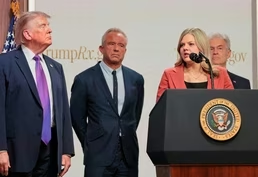
NewWhat to know about Dr. Heidi Overton, Trump's pick for FDA
Video has Closed Captions
What to know about Dr. Heidi Overton, Trump's pick to lead the FDA (5m 56s)
 New
NewWhy states say Meta designed addictive features for children
Video has Closed Captions
Why states claim Meta designed addictive features for children (5m 53s)
Providing Support for PBS.org
Learn Moreabout PBS online sponsorship New Episode
- News and Public Affairs

Today's top journalists discuss Washington's current political events and public affairs.

- News and Public Affairs

FRONTLINE is investigative journalism that questions, explains and changes our world.
 New Episode
 New Episode
 New Episode
 New Episode
 New Episode
 New Episode
 New Episode

Support for PBS provided by:
Major corporate funding for the PBS News Hour is provided by BDO, BNSF, Consumer Cellular, American Cruise Lines, and Raymond James. Funding for the PBS NewsHour Weekend is provided by...