
Investigators search for motive after pilot's alleged attack
Clip: 10/1/2026 | 5m 58sVideo has Closed Captions
Investigators search for motive after alleged attack by FlyDubai co-pilot
Investigators across the Middle East are hunting for answers after a co-pilot stabbed his captain and allegedly attempted to crash a FlyDubai aircraft bound for Israel. President Trump claimed the attack could be linked to Iran, but did not provide evidence. Geoff Bennett discussed what we do and don't know with Juliette Kayyem, a former assistant secretary at the Department of Homeland Security.
Problems playing video? | Closed Captioning Feedback
Problems playing video? | Closed Captioning Feedback
Major corporate funding for the PBS News Hour is provided by BDO, BNSF, Consumer Cellular, American Cruise Lines, and Raymond James. Funding for the PBS NewsHour Weekend is provided by...
Investigators search for motive after pilot's alleged attack
Clip: 10/1/2026 | 5m 58sVideo has Closed Captions
Investigators across the Middle East are hunting for answers after a co-pilot stabbed his captain and allegedly attempted to crash a FlyDubai aircraft bound for Israel. President Trump claimed the attack could be linked to Iran, but did not provide evidence. Geoff Bennett discussed what we do and don't know with Juliette Kayyem, a former assistant secretary at the Department of Homeland Security.
Problems playing video? | Closed Captioning Feedback
Where to Watch PBS News Hour
PBS News Hour is available to stream on pbs.org and the PBS app.
Providing Support for PBS.org
Learn Moreabout PBS online sponsorshipGEOFF BENNETT: Tonight, investigators across the Middle East are hunting for answers after a co-pilot stabbed his captain and allegedly attempted to crash a Flydubai aircraft bound for Israel with 174 passengers and crew on board.
The plane, traveling from Dubai, plunged 16,000 feet in roughly 60 seconds.
Passengers were ultimately able to subdue the co-pilot after the injured captain, now hailed as a hero, managed to open the cockpit door.
Today, President Trump said the attack could be linked to Iran, without providing evidence.
The suspect has not been publicly identified.
Israeli Prime Minister Benjamin Netanyahu said this morning on FOX News that the suspect was an Omani national.
But many major questions remain unanswered.
To help us unpack what we do and don't know, we're joined again by Juliette Kayyem.
She's a former assistant secretary at the Department of Homeland Security and is now a senior lecturer at the Harvard Kennedy School.
Thank you for being with us.
JULIETTE KAYYEM, Former U.S.
Department of Homeland Security Assistant Secretary: Thanks for having me.
GEOFF BENNETT: So, as you know, there are now competing claims about motive.
Israel's prime minister says the co-pilot underwent what he called Islamist radical indoctrination.
President Trump has pointed to Iran.
Neither has provided evidence.
The UAA -- UAE, rather, says it's investigating possible terrorist activity or prior planning.
What can we responsibly say, if anything, about the motive at this point?
JULIETTE KAYYEM: Right.
So and I'm glad you say that about responsibly say.
After every crisis, terror incident, disaster, there's a narrative that forms very early that is often pushed for political reasons.
I think we should just put those to the side aside right now, that that just happens.
There are elections.
What we do know is this, that there was - - that the leading theory has got to be that this was a terrorism incident, not because there's strong evidence, but just given that the totality of the circumstances.
You have a pilot who tries to essentially kill another pilot, down a plane that's filled with Israelis en route to Israel.
So any rational person would say that would be my leading theory.
What we don't know and the suspicion or allegations that this is related to a terrorist organization or even Iran is what that radicalization process was like.
It's important for us to get this right, because if it was self-radicalization, that's one thing.
If it was radicalization because of a group that was pushing it on, that's a different kind of remedy.
If it's state-sponsored terrorism, like Iran, a country that Israel and the United States have started a war against, that is a very different consequence.
And so those of us who are looking at the evidence would rationally say this is going to be the leading theory is going to be some sort of radicalization, but there are others, mental health issues that may have occurred in the pilot.
So that's where we are right now on the facts.
GEOFF BENNETT: And pilots already operate inside one of the most tightly controlled security environments in aviation.
Does this incident expose a particular vulnerability, when the potential threat comes from inside the cockpit?
JULIETTE KAYYEM: Yes, it's the catch-22 of sort of securing the cockpit.
So, just to explain the process, there is a U.N.
body called the International Civil Aviation Organization, 193 member nations, and we do that because the global aviation transportation system is shared.
And so there are minimum standards.
There are standards about who can fly, about what airplanes can fly.
There are then individual country standards.
And so that is what is going to be examined, either in terms of what kind of review is done in terms of mental health, physical health.
So you have two different systems that are supposed to complement each other.
On the inside of the airplane, you, of course, have the secure cockpit door or the secure cockpit area.
I have to say, even given what happened and the luck and fortitude of that pilot, who knew he had to open the cockpit door, there have been millions of flights with secure cockpits.
It's two pilots versus potentially 200, 300, 400 passengers.
And I think that any review of this will probably or hopefully still keep the cockpit secure, while also understanding that we need to maybe better screen pilots and screen what pilots bring into the cockpit.
GEOFF BENNETT: Well, yes, given your experience at DHS, what will DHS and the FAA be looking at here?
It's still early days, but could this lead to potential changes in domestic aviation?
JULIETTE KAYYEM: It could.
I think it will be mostly felt by the pilots.
Again, the secure cockpit -- and all of us experienced in it with the food tray coming out in front when a pilot leaves the cockpit is -- has worked very, very well.
This -- there have been a few incidences of a pilot trying to be bring a plane down and violence within the cockpit.
So I don't think there's enough evidence to change that primary post-9/11 rule.
It's just -- it has worked very, very well, given the number of flights that are going on.
I think where -- and hopefully you will see a push is, just a few days ago, the Senate passed a mental health for pilots piece of legislation.
It needs to be taken up in the House.
That would provide the services needed for pilots here in the United States if they're exhibiting stress or signs of stress.
GEOFF BENNETT: Juliette Kayyem, our thanks to you, as always.
JULIETTE KAYYEM: Thank you.
 New
NewCornell's handling of rape allegations faces more scrutiny
Video has Closed Captions
New details intensify scrutiny of Cornell's handling of gang rape allegations (6m 12s)
 New
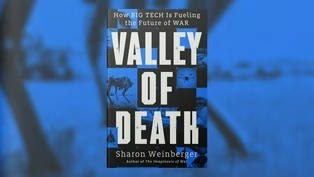
NewHow tech firms are replacing traditional defense contractors
Video has Closed Captions
'Valley of Death' reveals how tech companies are replacing traditional defense contractors (7m 32s)
 New
NewInside the UN peacekeeping mission on Lebanon-Israel border
Video has Closed Captions
On the ground with UN peacekeepers as Lebanon-Israel mission nears its end (7m 39s)
 New
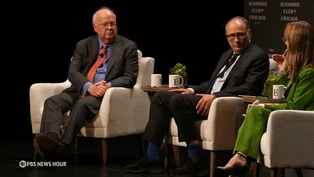
NewKarl Rove and David Axelrod give their midterm predictions
Video has Closed Captions
Karl Rove and David Axelrod give their midterm predictions (5m 52s)
 New
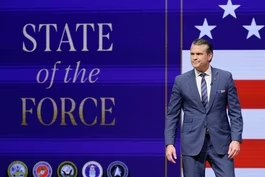
NewA look at Hegseth's attempts to reshape the Pentagon
Video has Closed Captions
A look at Hegseth's attempts to reshape the Pentagon (6m 22s)
 New
NewNews Wrap: SCOTUS to review mandatory detention for migrants
Video has Closed Captions
News Wrap: Supreme Court to review mandatory detention policy for migrants (6m 6s)
 New
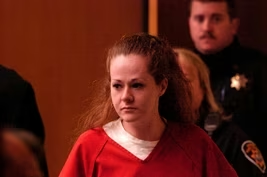
NewWhat we know about the botched execution of Christa Pike
Video has Closed Captions
What we know about Tennessee's botched execution of Christa Pike (6m 27s)
Providing Support for PBS.org
Learn Moreabout PBS online sponsorship
- News and Public Affairs

Today's top journalists discuss Washington's current political events and public affairs.
 New Episode
- News and Public Affairs

FRONTLINE is investigative journalism that questions, explains and changes our world.
 New Episode
 New Episode
 New Episode

 New Episode

 New Episode
 New Episode
Support for PBS provided by:
Major corporate funding for the PBS News Hour is provided by BDO, BNSF, Consumer Cellular, American Cruise Lines, and Raymond James. Funding for the PBS NewsHour Weekend is provided by...