
August 14, 2026
8/14/2026 | 55m 31sVideo has Closed Captions
Abhijeet Dipke; Gustavo Dudamel; Rebecca Lindsey
Abhijeet Dipke, head of the Cockroach Janta Party in India, on the demands of his national youth movement and how they have been able to effect change. Venezuelan Conductor Gustavo Dudamel discusses his upcoming seminal show, his career, and his work to help his devastated home country. Former NOAA employee Rebecca Lindsey on the climate website she created to replace the dismantled climate.gov.
Problems playing video? | Closed Captioning Feedback
Problems playing video? | Closed Captioning Feedback
August 14, 2026
8/14/2026 | 55m 31sVideo has Closed Captions
Abhijeet Dipke, head of the Cockroach Janta Party in India, on the demands of his national youth movement and how they have been able to effect change. Venezuelan Conductor Gustavo Dudamel discusses his upcoming seminal show, his career, and his work to help his devastated home country. Former NOAA employee Rebecca Lindsey on the climate website she created to replace the dismantled climate.gov.
Problems playing video? | Closed Captioning Feedback
Where to Watch Amanpour and Company
Amanpour and Company is available to stream on pbs.org and the PBS app.
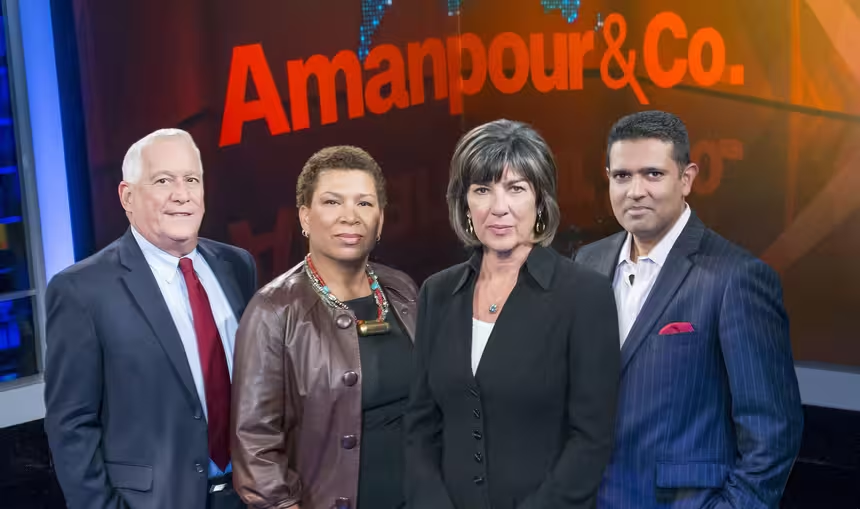
Watch Amanpour and Company on PBS
PBS and WNET, in collaboration with CNN, launched Amanpour and Company in September 2018. The series features wide-ranging, in-depth conversations with global thought leaders and cultural influencers on issues impacting the world each day, from politics, business, technology and arts, to science and sports.Providing Support for PBS.org
Learn Moreabout PBS online sponsorshipHello everyone and welcome to Amanpour & Co.
Here's what's coming up.
It was really heartbreaking to see that the police was using pellet guns against students.
But despite of that, despite of that, the students didn't go back to their homes.
They continued the protest and they responded to the brutality with means and humour.
Is India on the cusp of change as the youth take to the streets?
I speak to the head of its Gen Z street movement, the cockroach janta party.
Then... It's a moment.
It's a moment of connection.
It's a moment of interaction.
It's a moment of empathy.
And when you understand that, that it's not only the technical thing, it's not only the historical thing that it says, if not it's about feeling, then it changes everything.
The power of classical music with maestro Gustavo Dudamel.
We talk about his extraordinary career and his love for his homeland, Venezuela, which is still reeling from devastating earthquakes.
Thus... The administration disbanded all of those scientists and completely took the entire website offline.
So now all of the most authoritative reports on climate impacts in the United States have been taken down.
Extreme heat this summer, denial from the Trump administration, and the battle for accurate climate change information.
Amanpour & Co.
is made possible by committed to bridging cultural differences in our communities, and by contributions to your PBS station from viewers like you.
Thank you.
Welcome to the program, everyone.
I'm Christiane Amanpour in London.
In India, the youth are demanding they be heard.
This week has seen another protest movement escalate with thousands of young job seekers and students taking to the streets in one of the country's poorest states.
It is part of a weeks-long protest demanding reforms to the recruitment processes for government jobs.
And it comes just after the emergence of the Cockroach Movement, a youth-led campaign demanding exam and education reform.
It began with defiant irony online, but quickly grew into a national outcry, culminating in the resignation of the Education Minister.
So as the country gets ready to celebrate 79 years of independence from Britain tomorrow, the government and Prime Minister Narendra Modi's BJP party face one of the biggest and toughest challenges in years.
The resignation of the education minister was a rare concession for the leader, devoted to his own strong man image.
Now, Abhijit Dibke is the head of the Cockroach Janta Party, the face of India's first Gen Z movement that's resonating all over the world now.
He was recently a student at Boston University, and he's joining me from New Delhi.
Abhijit Dibke, welcome to the program.
Thank you.
You know, I wonder how it feels to be the focus of so much international attention, obviously attention in India, but people are looking at you and thinking, wow, this is the way to win politically.
How do you feel now about your movement after the education minister resigned, the government conceded, quite a lot of the points that your movement was demanding?
Actually, it feels really good because the protest has been successful.
We have been successful in getting the resignation of the education minister who was responsible for the death of more than 20 students who died by suicide because of the paper leak that happened in the medical entrance exam in India.
However, we believe that the resignation is not the biggest victory.
The biggest victory is that people have become fearless while questioning the government because there was a trend happening in India where people were afraid of speaking up, people were scared of questioning the government because whenever somebody used to speak against the government, they used to file cases against them, they even used to put them behind the jail and we saw even during this protest, there was extreme brutality done by the police officers against kids who were just 17-18 years old.
In front of my own eyes, the police actually beaten up a 12 year old girl, some of the male police officers even tried to grab the girls by their neck and they beat them with batons, tear gases and even pellet guns.
It was really heartbreaking to see that the police was using pellet guns against students.
But despite of that, the students didn't go back to their homes.
They continued the protest and they responded to the brutality with memes and humour and I think nothing could be more beautiful than that and this was truly a victory of democracy.
So let me ask you this because you mentioned the trigger and that was the leaking of these medical exams and the horrendous fact that as you say several people took their own lives over it.
Can you explain to us why it is so dramatic, why it is so stressful that young people in India felt that they had no chance and no choice other than to take their own lives?
We're sitting here in the UK this week as all A-level results and results for university come out, end of high school results.
What is it about the Indian ones that are so dramatically important?
In India, whenever a child grows up, he goes to school, there is a pressure on him, there is expectations from them, from the children that either they should become a successful, become a successful engineer or a doctor.
And you can see this across the world.
The majority of the people that you see across the world are mostly in the engineering field or even in the doctors.
They are mostly Indians.
And that is because in India that is considered as one of the most prestigious job one can have.
And that is also the parameter of your success.
So in India, either you have to become a doctor or an engineer and only then you will be considered as someone who has a successful career.
And that is why the children in India always face a lot of pressure while growing up even while studying, because they feel that if they don't become doctor or an engineer, they have failed.
Such is the situation and such is the, I would say, conditioning in the country.
And when there is this kind of conditioning, the students are already under a lot of stress, a lot of burden.
And they study for like 15 to 16 hours in a day for three to four years, right from the eighth grade, they start preparing for the engineering entrance exams and medical entrance exams.
And for that, there are all coaching institutions.
So the children go to a coaching institution as well as schools.
Yes, so I understand you've laid it out very clearly and on top of all that, apparently some two-thirds of India's population is under 35 years old.
So we'll get to that in a second, but you also are a student.
How did this suddenly come to be?
There you are working for your own academic progress and you get up and come to India having started this movement.
What happened?
How did it trigger it?
I had just graduated and completed my master's and after that I just saw the Chief Justice of India made a comment where he compared the youth with cockroaches and parasites for criticizing the system and I just made a tweet on that how can the Chief Justice of India can make a comment where he compares the youth with cockroaches and parasites and after that the whole thing blew up many people started reposting resharing that tweet and after that that led me to the idea why not launch a parody party political party which could be called as the cockroach janta party taking inspiration from the same word that the Chief Justice of India used to demean the youth.
And that particular satirical political party gained huge traction.
And then we launched our social media platforms for that satire or parodic political party.
But within four days, the Indian government banned those social media accounts on Twitter by calling me a national security threat.
And I was an international student, an Indian student in the US.
I was there on an Indian passport.
And my own government was calling me a national security threat.
Someone who has lived his entire life in India, someone who has studied in the country, and who has just came to the US in just last two years.
So I was very disappointed, very disheartened, more than that I was heartbroken that the government of my own country was calling me a national security threat.
And that is why I chose to come back to my country and to prove that I am not a national security threat.
I am a patriot and I love my country, just not in the way this government expects me to, but I do love my country.
So, it's very clear that, and you put your body on the line there to defend democracy in your own country.
So, what happens next?
Does this remain the CJP?
Will it still keep the name Cockroach?
Will you continue it as a political movement?
Or has it done what you wanted it to do, got the resignation of a minister, got concessions from the government?
Are you going to continue and do you think it has legs, so to speak?
Christian, I'm really happy to tell you that what began on 20 June in India, a sit-in protest that has spread across the country, now it's no longer just the Gen Z. The Gen Alpha in the country.
10-12 year old kids are protesting in their schools, especially the public schools where facilities are very bad.
The public schools in India are in complete shambles.
They don't have benches to sit on, they don't have drinking water, they don't even have washrooms.
And for that, the Gen Alpha, these 10-12 year old kids are protesting, taking inspiration from what happened during the Gen Z protest, and it has already been spread across the country.
So we do believe that what happened with the resignation of the Education Minister was just a beginning to seek accountability from the system.
And now everybody is starting their own protests demanding accountability from the system, from the ministers, and people are raising their voices like never before in the last 10-12 years.
Abhijit Dikai, you know because you've lived it that the Modi government has been very successful in essentially blanking out and suppressing a lot of political opposition, certainly media diversity and opposition.
But since your movement, the BJP, Modi's party, has now lost a constituency that it had held for three decades.
And it appears to be on shaky ground, especially under, amongst the young voters and young people.
Are you, is this something you think will expand?
Do you think his government is really on the defensive?
And two, are you a one issue party or does it go beyond all these education issues that you've just laid out?
Okay, to answer your first question, it definitely has the potential because we do believe that because the government was so adamant and had grown so arrogant in the last one decade that it stopped listening to the people.
And now the people have like got really frustrated, really fed up of this government.
And that is why we saw such a huge movement started with the Cochrane Janata Party.
And now we can also see its consequences even in the elections where they lost the seat where they were in power for last 30 years.
So of course, if they are not going to listen to the people, if they are just going to ignore the people and keep torturing them, keep harassing the citizens, this is what the result will be.
And to your second question, the corporate Janta Party will remain a public pressure group and education will be our core issue.
But apart from that, unemployment in India is the biggest crisis as of now, because 80% of the unemployed people in the country are degree holders.
In India, in today's time, having a degree is no longer considered as an asset, it has become a liability.
And people are really frustrated with that because the cost of living being unemployed has been really put people in a very difficult position where they are struggling for their livelihoods.
And what about, you know, you just said that you'd been accused by your government of being a threat, a national security threat.
As I said, you know, the mainstream media is not exactly a friend of diverse political parties who are opposed to the BJP.
Are you getting space?
Are they trying to blank you?
Do you think that you're able to get your message across or are you still just on social media?
How are you campaigning and organizing, in other words?
We are holding meetings in different parts of the country.
We have expanded our organization.
We have expanded our core team.
But yes, the government and the ruling party are still trying to suppress our voices.
Just yesterday, we were supposed to have a volunteer's meet where more than a thousand people had come together to discuss the road ahead.
And we had booked a venue but the owner of the venue was threatened by the ruling party members telling them that if you give venue to the cockroach janata party for a meeting, we will hang you upside down.
These are the kind of threats that the people who are giving venues to the cockroach janata party to hold meetings, these are the kind of threats they are getting.
And apart from that, they are doing something very notorious with meta on Instagram.
If you post anything with the word cockroach, the government has asked meta to suppress the social media reach of it.
So these are the things that they are trying to suppress our voices on social media and as well on the ground.
But I believe that it's going to be useless since the people are really fed up and now the people are no longer scared of this government.
And they will come out on the streets if the government keeps suppressing their voices.
Let me ask you something because you've probably heard this.
Obviously the government and those who oppose you have been saying that your movement is also under foreign influence, that some of this big social media traction is bots.
What is your answer to that?
They are free to investigate us.
Why are they accusing us?
You have all the machinery, you have all the agencies.
Why don't you just investigate us?
Why don't you just bring the fact sheet?
Why are you just keeping on accusing us?
Go ahead, investigate us.
And if we are guilty, give us the punishment.
But since they are not investigating, they are just only accusing, just to defame the movement.
And this is not the first time.
In last few years, whenever there has been a protest or whenever somebody has to speak up against this government, they have always been linked with foreign powers.
be it the farmers or be it the doctors.
whenever somebody has tried to speak against this government, they have always linked them with foreign powers.
Yeah.
So let me ask you finally, here you are, burst onto the Indian and the international stage.
But still I hear, correct me if I'm wrong, that your mother, as many, many Indian mothers and fathers want, to matchmake you, to get her son married.
Is that true?
Are you going to submit to the motherly pressure?
Are you going to go back to your college in the United States or are you staying right where you are?
I know I'm going to stay put in India.
I've come back to my home and I'm going to be here and I have already completed my studies in the US.
And so I'm not going to go back and come into the matchmaking thing.
Indian parents don't care what you do in your life.
They don't care at all.
The only thing they care about is when are you going to get married, when their kid is going to get married.
I'm not going to submit to that pressure because right now my top priority is to carry forward the movement, to carry forward the cockroach janta party and do whatever is possible to make a meaningful change in the country.
Well, Abhijit Dibke, I wish you good luck dealing with your parents and really it's going to be very interesting to watch your progress that has been so remarkable and so inspiring around the world.
So thanks for being with us.
Thank you, Richanne.
Thank you so much.
No matter how far you go, how high you climb, a mother has her priorities.
And of course, we continue to ask the Indian government for their perspective.
Now, this summer as ever, music is taking over London for the annual proms.
It's a 131-year-old classical music festival which is held at the Royal Albert Hall.
One of the main draws this year, the Venezuelan dynamo Gustavo Dudamel and the LA Philharmonic Orchestra.
He's taken that from strength to strength since he picked up the conductor's baton there 17 years ago.
And now he's going out on a high as he heads east to take over the New York Philharmonic.
It is a triumphant moment for Dudamel, but it's tinged also with some tragedy.
His homeland, Venezuela, still struggling in the wake of the devastating earthquakes that struck it in June, killing more than 6,000 people.
I spoke to Dudamel at the Royal Albert Hall about music, empathy, and why classical is never going out of fashion.
Gustavo Dudamel, welcome back to our program.
Thank you very much.
So if I could say, you are the "it man" of the conducting world, or the cultural world right now.
You're about to take over the New York Philharmonic from the LA Philharmonic.
You conducted the Muppets in half-time at the World Cup Final.
You are literally everywhere.
What does it feel like at this stage of your career to be so relevant still and so much part of the cultural dialogue?
I think, first of all, thank you.
It's so wonderful to be back talking to you.
It's such a pleasure.
I go back to my childhood.
I didn't want to be a famous conductor conducting the big orchestras.
For me it was like to be with my friends and having fun making music and enjoying what we were doing.
It's exactly the same thing.
When I have the chance to do this kind of crazy and amazing things, it's exactly the same feeling.
I think it's good in the sense of for young people, I'm not anymore as young as I was before, to be a reference, but for them to see that, you know, also classical music, it has a very fun and joyful side, which is not.
Well, that is actually really interesting.
I was going to ask you because the first half of your performance was Beethoven, and then you have more contemporary in the second half.
What is it about classical music that really strikes you?
And what makes it lasting?
Because people say, "Oh, you know, the kids don't care."
But they do.
I saw the age range of the people who came to see you here.
That's true.
You know, I think it's when you really understand the action of music, that is not only the entertainment, because then you start to compare, you know, this kind of music I like, this... when you see the action, all music, I will not put only classical music, is to be part of a very special dimension.
It's a moment.
It's a moment of connection.
It's a moment of interaction.
It's a moment of empathy.
And when you understand that, that it's not only the technical thing, it's not only the historical thing that it says, if not it's about feeling, then it changes everything.
When we play Pastoral Symphony for example, Beethoven wanted for people to feel, not only to listen to music, if not to feel that they were in the summer enjoying the nature and all of that.
I think for us it's very important to, with our soul, you know, sometimes it's too intellectual but with our soul, to really try to transmit that.
Because people sometimes they come to a concert and you close your eyes and you are listening but at the same time you are feeling an energy.
That dimension is unique and that is why it's so important for our world that it's getting so disconnected when you are in a concert hall, you are sitting so tight next to each other, so you are really connected.
I think it's a very powerful thing.
I don't know whether you turn around, I know you do, but maybe not in full conducting, but between pieces, and saw the people on the floor.
Standing.
So there's all these beautiful seats, but there are a lot of people on the floor.
And I noticed quite elderly people had managed to get their way to the front and were leaning against that bar and there were younger people at the back.
When you see elderly people stand still and younger people for hours just listening to you, how does it make you feel when you see the audience?
Well, I think, you know, then we succeed.
You know, that is I think the moment that you say like people love what they are what they are receiving, you know, but not only receiving, you know, it's also that connection is that interaction is not only what happened on the stage is that person that is standing there making an effort, but that effort disappears.
It becomes joy, it becomes, you know, connection with beauty.
And that is the best.
So, you know, you were talking about being young and how this has been in your blood, in your body, since you were a young man.
Your father was very musical and in Venezuela you joined the El Sistema system, which was created to allow disadvantaged youth to partake in this kind of elitist thing, which is classical music.
But it blows my mind when I read that, you know, you conducted your first orchestra at the age of 11.
Yeah, yeah.
But that is... How did that come about?
Tell me about it.
Well, I was conducting before at home, the recordings and my toys.
You were conducting your toys?
My toys.
And with the big orchestras.
I always, when I arrived to rehearse to these huge orchestras, I said, "I conducted you when I was seven, eight years old."
And I rehearsed.
I destroyed the LPs.
I was going back, stopping, "It's not together, this softer."
And I went back and back and back.
When I was 11 years old, I was playing in an orchestra.
It was called the Amadeus Chamber Orchestra.
It was a youth orchestra that we have in my town, in my hometown, Barquisimeto.
The conductor was late.
I went to the podium and I started to conduct.
I remember I was trying to imitate Herbert von Karajan.
Because in all the videos I never saw him live.
He was the legend, right?
He was a legend, Berlin Philharmonic.
But in the videos he always conducted with his eyes closed.
And I was conducting with my eyes closed.
And then I started to listen like people were getting serious.
And then when I opened my eyes I saw the conductor of the orchestra.
My career is finished in music.
Because I said, I was imitating him, I was imitating the other teacher, I was imitating the big conductors, and then he said like, "Oh, oh, oh, keep doing, keep doing the rehearsal."
And then he said at the end of the rehearsal, "Look, you're good in this.
You want to be my assistant conductor?"
And that was the beginning.
Let me just ask you about Venezuela, because boy, oh boy, Sistema kind of put it on the cultural map, but right now it's on the political map.
When we spoke before, you were very reluctant to talk politically, but things have really moved on.
The United States, essentially, is running Venezuela.
What do you think when you think about your country's future right now?
Well, look, as you know, it's a very difficult situation.
But at the same time, I think it's a moment that we have to take an opportunity to get out of this very tragic and difficult situation.
I think that people are tired of politics.
If you talk to a Venezuelan that is there, they are tired about that polemic thing of politics.
They want to get out of the situation.
And I think it has to come a new time when we rebuild the country, not only economically, but through the education of people, through a new vision of a new Venezuela that is not only that we are great people, good people, resilient people that do, if not, you know, we are strong and we can build something.
You know, I'm part of a program that you know, have crossed 9, 10 or 11 governments.
It has not survived, it has, you know, strongly lived, you know, the life of Venezuela in the last 50 years.
And it's still there, producing wonderful citizens, not only musicians, citizens, you know, because it's not a musical factory, the sistema.
Sistema is, we use music to transform the life of children that can be doctors, engineers, workers, whatever.
And this is the thing that we have to see.
If the country, if we behave as an orchestra that maybe is an utopia, we can say like, yes, we cannot live by harmony, but yes, we can create harmony.
But we have to be able to listen to each other first, to respect each other, to make justice, and then to create something that works.
You knew the Chavistas, you knew Del C, and now you know the United States.
You've been there for 17 years in Los Angeles with the Philharmonic.
You're a major figure there.
And you are also an immigrant at a time when immigrants are under massive pressure and attack by this particular government and actually frankly previous ones, but especially by this one.
How do you resolve that in your mind?
You know that half your, maybe your orchestra is terrified of being rounded up and deported, and yet you are somebody able to maybe be a bridge.
Do you ever see that?
Well, yes.
I think we have responsibilities as public figures, but we have to know how to use that.
We are in a moment that everything is so flammable.
So whatever you say, it creates an opinion and it increases the bad side.
It's incredible because we live in a world that everything is happening so fast that we are getting addicted to the bad things, to have that information.
That's really interesting, you're getting addicted to all the bad things.
Exactly, all of this unrest, all of this fight.
We have to open a space where there is not that empathy.
When you have empathy, you don't have to agree with the other.
You listen to the other.
You don't have to respect the opinion.
You listen and you create your space to create a bridge and a balance between the two opinions.
If not, where can we arrive?
I was struck by what you said about El Sistema.
It was about all sorts of disciplines, including the discipline of joy.
In other words, joy is in fact a discipline that needs to be worked on.
Absolutely.
Because harmony is a discipline.
We only talk about harmony specifically with the Course and all of that.
But harmony is a spiritual thing that we live, all of us.
When we discipline our harmony, for me, for myself, in this noisy world, what is my exercise every day?
To balance my harmony.
Every day I take my time to be in silence, but not in silence completely like a silence that we understand.
It's a lot of sounds, it's a lot of voices there, and how I can balance that.
How I can say something that maybe can heal and not destroy.
Talking about destroy, obviously Venezuela had a catastrophic couple of earthquakes, and you are one of your last performances with the LA Philharmonic, is to do a concert for Venezuela.
Where will that take place?
How do you feel doing that for your own country?
What do they need?
Well, it's catastrophic because this is like something like, you know, we have one crisis and it comes another one that it creates this very difficult situation.
But of course, we have to unite forces and create, you know, ways to support all of this situation, which it will take a lot of time to recover.
Because the thing is that sometimes things happen and then in a few days people forget because there are other things happening.
So that is why for me, it's taking time to build something that we can think in rebuilding in the future.
And look what happened also in Colombia just a few days ago.
So I think the earth is talking to us and I think this concert is going to be very special.
Do you find young people still really attracted and interested in classical music?
You don't think it's a dying art?
Completely.
I don't think it's a dying art.
It depends on how you see it.
For example, we went with the Lathfield Harmonic to Coachella.
And that was historic.
That's the great rock concert in the desert in California.
I don't know Every year.
We had the chance to go there last year and we mixed.
We played Bach, Beethoven, Strauss, John Williams, Stravinsky, together with LL Cool J, Leve, Cynthia Evo, David Grohl.
We combined all of that and it was beautiful.
It was an amazing journey.
But you really have to take the risk, but not as a... It's not an obligation.
It's a need.
You have to do this and understand that this is a way, it's not to conquer but to really make people feel that they belong.
You know, art is a result of, it's the most beautiful result of humankind.
Now, it's no secret that LA on the West Coast and New York on the East Coast are competing on everything, including their philharmonics.
And one side says, "I'm the best," the other says, "I'm the best."
How are you going to deal with that?
No, I think they are sisters.
I don't see a competition.
I think culturally each orchestra is different because of their own background, their own lifestyle, the place, what they culturally offer but I don't see a competition between the two orchestras.
What made you want to take the New York job?
Well, I think it is because I think 17 years, 20 years with the late Philharmonic, it has been such an amazing journey.
I don't see this as an end.
It's not the end of the book.
It's an end of a chapter.
It's one of the oldest orchestras in the United States, same year 1842 was founded the New York Philharmonic, same year of the Vienna Philharmonic.
So it's a place that I love.
I love New York since I came the first time.
And I have the chance to create also a new home, but not leaving the old home.
Apparently you're keeping your apartment just in case.
As in Venezuela, I left Venezuela to work in Los Angeles, but you never leave your home.
It's always your home.
Did your home survive?
Yes.
Yes, great.
Yes.
It suffered, the things, but not as others.
But yes, you are creating homes.
It's the life of a conductor, you know, when you have the chance.
That is different with soloists, because soloists, they have to travel everywhere and be different places.
When you are a music director in an orchestra, you are settled for a long amount of time, where you can develop a home.
So I created a home in Los Angeles, now I'm creating a home in New York.
So I'm blessed to have... You are and so are they.
Gustavo Dudamel, thank you so much for being with us.
Thank you so much.
And just before he takes over on the East Coast, he's going to be going out with a final bash that perfectly blends his love of America and Venezuela.
He'll host the Benefit A Concert for Venezuela next Sunday at the Hollywood Bowl.
And The Proms is available on BBC iPlayer and BBC Sounds for viewers in the UK.
Now here in Britain we're experiencing yet another massive heatwave.
In fact, the fifth of the season to hit Europe and the world's oceans reached their highest temperatures ever recognized for July.
Now more than ever, people need reliable information.
And in the United States, the federal government's climate.gov website has been considered one of the most trusted sources of climate information.
That is until the Trump administration shut it down.
The site's manager, Rebecca Lindsey, was laid off along with all of her colleagues.
And she lays out the stakes with Hari Sreenivasan.
- Christiane, thanks.
- Rebecca Lindsey, thanks so much for joining us.
So in 2025, the Trump administration laid off hundreds of employees of the National Oceanic and Atmospheric Administration.
Shortly after, the website that was called climate.gov, that was a critical source of climate information, was shut down.
And as the website's program manager, you were among the 280,000 federal workers who lost their jobs during that period.
Rebecca, I guess first of all for people who are unaware, what is climate.us and why does it need to be in the first place?
Climate.us is the nonprofit successor of NOAA's climate.gov website.
We are a public information portal to provide climate information, data, tools, educational resources to the public to help people understand climate and to make decisions to protect themselves and the things they care about.
So what happened to climate.gov?
The new administration in winter of last year shut down the entire program.
I was a federal employee.
I was fired within a couple of months.
The remainder of my teammates who were federal contractors were removed from their contract and the whole team was basically disbanded.
And you have been working there for how long?
Give me an idea of how large the team was and what you would do to put this site together.
I think it was a great idea.
It was a great idea.
We had been there about 15 years.
Climate.gov wasn't just a website.
It was a climate education and literacy program that NOAA supported to help NOAA understand what kinds of information the public and teachers and the media wanted about climate and then provide that for them.
At the end of 2024, if an American Googled climate in their browser, climate.gov was the top organic result.
We had been working very hard.
We had more than 600,000 followers on social media.
The team took very seriously our duty as public servants to try to help the public find the information about climate that they needed.
So the administration didn't specifically say why this was being shut down.
When you go to the old site, there was a message for visitors that said, "In compliance with Executive Order 14303, future research products previously housed under climate.gov will be available at NOAA.gov/climate and its affiliate website."
So when you look at that, doesn't the information still exist and isn't it still accessible to Americans?
Well what you'll notice is when you go to NOAA.gov/climate, that was the home page of climate.gov has been redirected to that page permanently and then all of the links on that page that previously pointed users back to resources on climate.gov have been stripped from that page.
So essentially, it's what they've done is it's sort of like they renovated a store and had the front door open into a closet.
You go in, there's no pathway out to the kinds of information that we had on climate.gov.
Now, it's true that there's lots of climate information still available from NOAA.
You will find the climate data, the monthly reports, the annual summary of the state of the climate.
So you will find things that tell you, for example, that 2025 was, you know, so many degrees above the pre-industrial average.
What you won't find any more easily is any explanation of why that is, why the past 10 years have been the hottest years in the historical record.
No discussion about the human influence on climate or the potential impacts that the world and the country is going to experience from climate change.
They have sort of, they seem to have retreated to a position where all they're going to do is provide data.
They're going to have a server, they're going to have, you know, they're going to have files that, you know, people can download and get data.
But what Climate.gov did and what Climate.us is going to do is build that bridge between the data and the public that needs things explained with non-technical terms in plain language.
We made a big effort to go to the data and develop data visualizations and graphics that tell the story so that we're not just telling people global sea level is rising.
We go to the data, we pull it, we make a map, we show people this is how sea level has risen in the past century.
That sort of bridge building and interpretation and context, that is what the federal government, and NOAA in particular, is retreating from.
I mean, you can see the numbers, but without any kind of interpretation, we're not going to make policy decisions on what's important to us based on those numbers if we don't really understand what those numbers mean or what context they're in.
Yes, I think one thing that we heard a lot, we got a, we had our fair number of critics, and all the years we were operating at NOAA, people who deny the reality of climate change would write in and complain to us.
And frequently, their criticisms and their outrage revolved around this idea that somehow science was trying to tell them what to do.
Science is, you know, you're giving us this information and now you're forcing us to make changes we don't want to make or interfere with the free market in ways we don't like.
But the science only tells us what's happening.
What we choose to do about it, that is based on our values, based on what matters to us.
And the reality is, climate, responding to human-caused climate change is not just going to be about reducing our emissions.
We have to think about adaptation and resilience at the same time.
I wish that people would accept that science and scientists are not trying to tell us what to do.
They're trying to tell us what is going to happen and why would we not want to have that information.
Can you tell me a little bit more about the information that is now missing from the government websites?
Climate.gov, as I say, technically the site is still there, but the entire website of the U.S.
Global Change Research Program, which is the congressionally mandated organization that Congress created in 1990 to help the nation understand and prepare for the impacts of human-caused climate change.
The administration disbanded all of those scientists and completely took the entire website offline.
So now all of the most authoritative reports on climate impacts in the United States have been taken down.
At the EPA, a whole section of the site which had what they called their climate change indicators, which is all kinds of different data-driven examples of how climate is affecting things that Americans care about, like streamflow and the timing of the spring growing season.
All of those different indicators of how climate is affecting our world have been taken down.
So there's just, again, it's that collection of resources that are interpreting the science and the data for a non-technical audience.
Those are the resources that are disappearing from across the federal science space.
- In this restoration, you're working with just two other women here, one including your sister who is also part of the agency.
But how are you managing to try to keep a copy, essentially, of an entire federal site with just three people?
Well, so we are very fortunate that in addition to sites like the Internet Archive, there was -- people began in late 2024 anticipating that the government, the new administration, was not going to be friendly to climate.
And so people began making clones of the site, and the technology now exists that pretty much anyone can go to a website and clone it.
So we have the technical challenges are actually the least of our challenges.
And we were the fact that we, you know, the fact that we were able to stand up a almost complete clone of the site with just our three people.
And then we hired contractors using some of the crowdsourced funding that we have raised.
We launched essentially a GoFundMe when we started this initiative.
And we used that money to hire web developers to rebuild the clone of the site that launched at the end of June.
The hard part is restoring and resuming our day-to-day operations, producing stories, engaging with our audience, you know, keeping abreast of what's in the news and trying to understand what kinds of climate information would be relevant to public and current events.
That takes a team, and it's a team that we don't yet have the resources to hire.
I'm the writer and the editor.
My sister Mary is the lead data visualizer.
We have another woman named Anna Eshelman who is our graphic design and layout person.
But we really need double that staff.
And that the government, I would argue, was the right person, the right entity to support that because this is in the realm of public education.
This is the kind of thing that benefits all of society.
And finding foundations and private donors to support this work, it's been a challenge.
And we still aren't sure exactly how much of Climate.gov's operations and activities we're going to be able to actually resume.
But we're just we've taken this risk and we're just going to keep trying So I wonder has the tone of the content changed have you been writing differently?
Have you been a bigger advocate?
because it seems like if you had none of the restrictions of the government that perhaps some of the content would be different or do you have kind of a different goal in mind?
At this point we do not intend to change our editorial focus or our workflows.
We take very seriously and we take pride in the fact that some media watchdog websites describe us as pro-science but non-partisan and that's a reputation and a standard that we we intend to keep.
We do not intend to begin doing more advocacy for getting people to do something about climate.
What we what we may do that's different is NOAA's mission did not extend very deeply into the science of mitigation of climate change.
And there is science behind all of these ideas that people are considering for not just reducing emissions, but potentially enhancing ocean natural processes in the ocean to sequester more carbon, planting more trees to absorb more carbon.
There's even technology that's being studied and tested to do what's called direct air capture where they literally come up with ways to suck carbon dioxide out of the air and turn it into fuel or turn it into carbon fiber to be used to build things.
We might have the capacity, the ability, now that we are no longer, you know, under NOAA and solely focused on NOAA's mission, we might have the ability to begin publishing content and explainers about the science behind mitigation.
But even if we do sort of widen our editorial scope topic-wise, the framing is always going to be the same.
It is about the science of these things and not about trying to persuade people or companies to do those things.
We want to stick very strongly to nonpartisan providing information.
I wonder if a more climate-friendly administration comes back into office.
Do you want to hand over the keys to climate.us?
I mean, is the goal here to create something that will outlast every administration that comes in, regardless of who's... That is our goal.
Yes, I'm sorry to interrupt you there.
That is our goal.
We, you know, the fact that this was... that it was so easy for this administration to dismantle all of these communication activities around climate science.
I think it's, you know, I consider it evidence that we should not make a site that has such an important mission so vulnerable again.
I also think that potentially bringing it out of the federal firewall creates an opportunity to partner more broadly with organizations across different levels of government, state governments, tribal governments, local communities.
And so in a way, it may make the site more able to be the all of society source of information that the country really needs.
However, we don't know what's going to happen.
Are people trusting institutions less where they're willing to believe climate.us is just as credible as the site that it's replacing?
That's an important question and it's one that is sort of, you know, I have to consider it an open question.
It's a hypothesis.
We know that people did over the past 20 years or so, or 20 years ago, did consider the federal government and the science agencies of the federal government to be authoritative, credible sources of information.
And we leveraged that.
Climate.gov's popularity and reach and trust from our readership, it did play -- it had to have played a part.
And it's very kind of mind-bending to think about there would have always been a minority of people who didn't trust the government and didn't trust us simply because we were government.
And now we're in this position where a whole different kind of American mistrusts the government because of what's happened in this administration.
And so, you know, yes, there's a possibility, a risk, that being outside of the federal space, we will struggle to have the same level of perceived credibility and authoritativeness.
But there's also the risk that going back, trying to let the government take back over this kind of operation is going to have a whole new, larger crop of Americans who do not trust it.
And our plan is to try to work with scientific organizations, but also to try to go as deeply as we need to into communities to find the people that different segments of America think are reputable and trustworthy and connect with them and say, "Okay, what do you want to know about climate?
How could we help you find the data and the tools and the things that you and your community need to make decisions and to feel more secure?
We are probably just going to have to work harder to build those relationships and not rely on the cachet of the federal brand.
The director and managing editor of Climate.us, Rebecca Lindsey, thanks so much for your time.
Thank you.
And finally, nobody does it better, and she's not so vain.
She is the singer Carly Simon, who makes her return this weekend with her first album of original songs since 2008, while also battling a debilitating disease.
My dear extremely forlorn friend, I hear your love has stormed out the door.
That's called Howl, the very beginning of her new album, Comes in Waves, featuring Simon's trademark poetry and her wit.
And it also comes at a time of great personal struggle for the 82-year-old artist who recently revealed that she's got Parkinson's disease.
In a touching and candid open letter, she also discussed composing her new work, writing, "There were melodies, verses and ideas written down and tucked away for some unknown future when I would have the time and attention to finish them.
Apparently," she says, "that future is now."
And that's it for our program tonight.
If you want to find out what's coming up every night, sign up for our newsletter at pbs.org/amanpour.
, , ,
 New
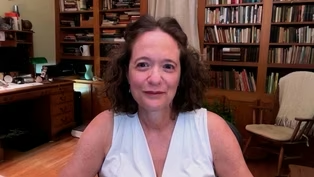
NewTrump Dismantled climate.gov. This Former NOAA Employee Rebuilt It
Video has Closed Captions
Rebecca Lindsey discusses creating Climate.us. (18m 10s)
Providing Support for PBS.org
Learn Moreabout PBS online sponsorship New Episode
- News and Public Affairs

Top journalists deliver compelling original analysis of the hour's headlines.
 New Episode
- News and Public Affairs

Today's top journalists discuss Washington's current political events and public affairs.
 New Episode
 New Episode
 New Episode
 New Episode

 New Episode

 New Episode
Support for PBS provided by: