
Life Inside a Glacier
Clip: Episode 3 | 3m 39sVideo has Closed Captions
Could life beyond Earth hide in ice? Dr. Birgit Sattler finds tardigrades thriving inside a glacier.
Found by accident in 2007, a hidden ice palace lies deep inside a glacier in Austria's Tyrolean Alps. Inside, ecologist Dr. Birgit Sattler reveals that ice is never sterile: bacteria, algae and tardigrades thrive in channels between the crystals. Their world may hint at life beyond Earth, and as glaciers melt, it flows downstream to seed rivers and soils.
Problems playing video? | Closed Captioning Feedback
Problems playing video? | Closed Captioning Feedback
Life Inside a Glacier
Clip: Episode 3 | 3m 39sVideo has Closed Captions
Found by accident in 2007, a hidden ice palace lies deep inside a glacier in Austria's Tyrolean Alps. Inside, ecologist Dr. Birgit Sattler reveals that ice is never sterile: bacteria, algae and tardigrades thrive in channels between the crystals. Their world may hint at life beyond Earth, and as glaciers melt, it flows downstream to seed rivers and soils.
Problems playing video? | Closed Captioning Feedback
Where to Watch Ages of Ice
Ages of Ice is available to stream on pbs.org and the PBS app.
Share Inspiring Moments From The Film
Explore the PBS Giphy collection for Ages of Ice.Providing Support for PBS.org
Learn Moreabout PBS online sponsorship♪ Narrator: High in the Tyrolean Alps lies a secret world.
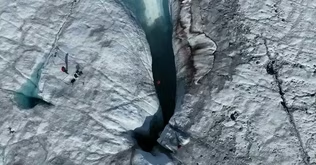
Discovered by accident in 2007, when a mountaineer peered into a small crack in the glacier and found a labyrinth of frozen chambers buried within its glittering heart.
A palace of ice, with vaulted halls dripping with frozen chandeliers like the ruins of some lost Arctic Versailles.
Well, the ice is like a massive treasure box.
It tells us a lot about the climate, but it's also a treasure box of a whole lot of biodiversity.
So it harvests life in all different kinds.
For ecologist Birgit Sattler, this frozen underworld reveals a hidden menagerie of ice creatures most of us never knew existed.
Ice is never sterile.
Nobody would have thought that little tiny animals, organisms, that can live inside the ice.
But here we are.
There are bacteria, there are algae, there are fungi.
There are also some metazoans, like tardigrades or the glacial flea.
We just see ice now as a solid block, but it's just a mingling of ice crystals.
And inside these tiny channels they can move around.
Ice is also not just like distilled water.
They also have nutrients and salts.
Narrator: Inside the ice, the mini ecosystem is surprisingly busy eating, reproducing, and quietly shaping the chemistry of the snow.
The type of microorganisms living in this ice have existed for millions of years.
Like nature's closest thing to an unbreakable toy, tardigrades, are able to live for decades without food or water, tolerate temperatures hotter than a kitchen oven, and even survive the frozen vacuum of space.
With creatures like this living in the ice, it's easy to see why scientists believe our icy worlds are a window into space.
Life in ice is like a holy grail.
Also, when you think about astrobiology, how could it be on other exoplanets which are ice covered?
I would be quite positive that if there is life that it would be in ice.
Narrator: These tiny ecosystems may appear trivial, but as ice melts.
The microbial biomass gets carried downstream into rivers and soils, seeding entire ecosystems.
Feeding aquatic life, and fertilizing landscapes far below.
Rippling all the way down the mountain, through streams, forests, and beyond.
Antarctica's Air-Eating Microbes
Video has Closed Captions
Clip: Ep3 | 3m 54s | No sunlight, no soil to eat. In Antarctica, Dr. Ry Holland finds microbes surviving on thin air. (3m 54s)
Providing Support for PBS.org
Learn Moreabout PBS online sponsorship New Episode
- Science and Nature

Explore scientific discoveries on television's most acclaimed science documentary series.



 New Episode
 New Episode







Support for PBS provided by: