
Visionaries
Discover the risk-taking ancestors of Richard Branson, Maya Lin and Frank Gehry.
From
Finding Your Roots
Visionaries
Season 3 Episode 5 | 52m 40sVideo has Closed Captions
Discover the risk-taking ancestors of Richard Branson, Maya Lin and Frank Gehry.
Discover how the ancestors of business mogul Richard Branson and architects Maya Lin and Frank Gehry took audacious risks to create opportunities, and how their luck, ingenuity and chutzpah was passed on to these three visionaries.
From
Problems playing video? | Closed Captioning Feedback
Problems playing video? | Closed Captioning Feedback
Corporate support for Season 11 of FINDING YOUR ROOTS WITH HENRY LOUIS GATES, JR. is provided by Gilead Sciences, Inc., Ancestry® and Johnson & Johnson. Major support is provided by...
Support provided by:


Finding Your Roots
Visionaries
Season 3 Episode 5 | 52m 40sVideo has Closed Captions
Discover how the ancestors of business mogul Richard Branson and architects Maya Lin and Frank Gehry took audacious risks to create opportunities, and how their luck, ingenuity and chutzpah was passed on to these three visionaries.
From
Problems playing video? | Closed Captioning Feedback
Where to Watch Finding Your Roots
Finding Your Roots is available to stream on pbs.org and the PBS app.
Buy Now
Explore More Finding Your Roots
A new season of Finding Your Roots is premiering January 7th! Stream now past episodes and tune in to PBS on Tuesdays at 8/7 for all-new episodes as renowned scholar Dr. Henry Louis Gates, Jr. guides influential guests into their roots, uncovering deep secrets, hidden identities and lost ancestors.Providing Support for PBS.org
Learn Moreabout PBS online sponsorshipI'm Henry Louis Gates Jr.
Welcome to "Finding Your Roots".
In this episode, we'll explore the family histories of entrepreneur Richard Branson and architects Frank Gehry and Maya Lin, three people who've transformed our world through the sheer power of their creative vision.
I mean, I've known in my office as Dr.
Yes.
I just find in life that saying yes can get you into trouble, but it's a lot more exciting than saying no.
When it was first completed, many of the museum directors, they say I compete with the art.
And it doesn't.
One reporter said, "Don't you think it's ironic that this is a memorial to Vietnam, and you're of Asian descent?"
And I looked 'em straight in the eye and I said, and I really believed it, "Well, that's irrelevant."
To explore their roots, we've used every tool at our disposal.
Genealogists have uncovered the paper trail their families left behind, while geneticists used the latest advances in DNA analysis to expose secrets hundreds of years old.
And we've compiled everything into a book of life, a record of all of our discoveries.
I'm just sort of getting some memories flooding back.
Close your eyes and make a wish.
You know where your family got the name Lin?
No.
Do you know?
Yeah, I know.
Richard, Frank, and Maya are three of the boldest visionaries I've ever met.
Now, we will reveal how their ancestors were just as audacious, ancestors who took great risks to lay the foundation for their daring achievements.
I've been inspired by Richard Branson since I first heard his story.
At just 20 years of age, he launched a mail order record business.
Growing exponentially, Virgin became a music studio, then a label, and then an international brand.
Richard ultimately parlayed his business acumen into Virgin Atlantic Airways.
So Richard Branson, where do you come from?
Who are your people?
Well, I know there's one or two people I'd love to be related to.
I love a, Sir Frances Drake.
Give me, give me that please.
I love adventures.
I'm absolutely fascinated to see what you found out.
Richard genuinely enjoys leading his business ventures into uncharted territory, so it shouldn't come as a surprise that his adventurousness was rooted in his upbringing.
As a boy, Richard was encouraged to be independent in a very unusual way.
Famously, my mom, she would be arrested today for this.
When I was about five or six, she pushed me out of the car and told me to make my own way to granny's house, which was about five miles away and I got very lost.
But you did make it.
I survived.
But that was her way of trying to get us to, yeah, stand on our own two feet.
His spirit couldn't be contained in the elite British boarding school to which his parents sent him as a boy.
When you were eight, you left home to go to Scaitcliffe.
Is that when you discovered that you were dyslexic?
I discovered I was thick.
The word dyslexia didn't exist in those days.
Of course.
Unfortunately, I was very good at sport, which compensated for the fact that I wasn't good at maths or science or anything else.
In addition to his athletic skills, Richard displayed early signs of his entrepreneurial spirit, starting a magazine called "Student" when he was still in high school.
The Vietnamese war was going on, so I decided to start a magazine to campaign against it.
Anyway, I learned the art of blather quite early on and somehow covered the printing and the paper cost for 50,000 copies of the magazine.
50,000 copies?
50,000 copies.
Wow, man, That's a lot.
It was, it was a lot.
Is it true that that headmaster at Scaitcliffe said to you, "I predict you'll either go to prison or you'll become a multimillionaire."
That was his leaving words to me and he said, "You either got to do your schoolwork or you've got to do the magazine."
And so that was the last day at school.
Richard never looked back.
Today, he's a multi-billionaire.
And true to his exploratory nature, he wants to revolutionize tourism through space travel and start flying customers to the moon.
You know, you improvise like a jazz musician.
I think that if you don't improvise, you disappear very quickly.
And I suppose I spent my life trying to create things I can be proud of and then hoping that the figures will, you know, stack up at the end of the year.
Like Richard, my next guest, Frank Gehry, has a unique way of seeing that's often run boldly against the status quo.
How'd you think of making buildings look like crumbled aluminum foil?
Frank has created some of the most iconic buildings of our time, including a branch of the Guggenheim Museum in Bilbao, Spain that is among the most spectacular works of art that I've ever seen.
Even at 87, he's still in demand all over the globe.
But of course, it wasn't always that way.
Not everyone was enamored of one of his early designs, his house, which he constructed out of repurposed scrap materials.
All my artist friends were doing things with plywood and metal and so I decided to wrap the old house with a new house.
But you invented a new way of seeing.
It was weird to the architecture world.
They thought I was a joke.
What was harder to deal with, the reaction of your fellow architects or of your neighbors?
The guy from across the street who had trailers in his backyard, had chain link fence, had a car on the lawn, came over and said, "What the hell are you doing?"
I said, "I'm being your neighbor.
You got chain link?
I got chain link."
He said, "But mine's normal."
Born Frank Goldberg in Toronto, Canada.
He was raised primarily in the rural Canadian mining town of Timmins.
What was it like being a Jewish kid in Timmins?
I was the only one at this school.
Up until 13, I bought into it all.
My grandfather read to me from Talmud.
Talmud starts with "Why?".
Great, great gift to give a kid, the right to be curious.
And that stuck with me.
Frank's curiosity and his ambition led him to Los Angeles in 1947, where he took odd jobs while attending night school.
Initially pursuing a major in fine arts, he soon realized that his passion lay in architecture.
Architecture had a chance of making a difference.
But that was just your sensibility.
Yeah.
It seemed like a humanitarian effort to build places for people to live in, to congregate, to be with each other.
Sadly, Frank's humanitarian impulses weren't embraced by all.
He frequently encountered antisemitism within the architecture community.
At his wife's urging, he finally decided to change his name.
And when he was 25 years-old, Frank Goldberg became Frank Gehry.
I copped out, there was a weakness at one point.
My father really got angry with me.
Why Gehry?
I mean, where did that name come from?
So they keep bringing names to me.
And when I got Gehry, G down, E, middle, H up, R, middle, Y down.
It had symmetry.
Yeah.
And the kid sitting on them.
Like Frank and Richard, my third guest, Maya Lin, is also thoroughly unconventional.
Maya made architectural history when she was just a 21-year-old undergraduate by designing one of the greatest works of public art ever conceived, the Vietnam Veterans Memorial in Washington, DC.
She's been a superstar ever since.
Today, she designs in her New York City studio where she showed me some of her works in progress.
That's great.
This is fabulous.
And so in my art, I'm always trying to get you to look at natural phenomena.
Maya continues to design memorials as well as thought-provoking sculptures, installations, and landscape art across the country.
As I began exploring her roots, I wasn't surprised to learn that much like Frank Gehry and Richard Branson, Maya traces her talents back to the influence of her family.
Now there you are, Maya Lin, born October 5th, 1959 in Athens, Ohio, home of the famous Ohio University.
What was it like to be the child of two professors?
It was great.
The art school was my playground, and to this day, I'll always recognize the smell of an English department and love it.
So I think you grew up with this very sheltered background where all that mattered was what you were thinking, and it was kind of a great way to grow up.
Maya left Ohio to pursue a degree at Yale, where she enrolled in a class on funereal architecture.
She decided to transform the staid, pious realism of traditional war memorials into a form more abstract, open, and empathetic, a form through which a viewer could feel the enormity of the loss of life in war.
For so much of time, it was literally the victor.
The foot soldier didn't matter that much.
The general on the horse.
It's the general on the horse.
The rearing horse.
You got it.
And I was definitely interested much more in the psychological and political ramifications.
As part of the final project for the class, students were assigned to create proposals for a recently announced competition to design the Vietnam Veterans Memorial.
Maya's professor didn't seem to be particularly impressed, but that didn't stop her.
He gave you a B+.
He gave me a B+.
He didn't like my approach to funereal architecture.
It was an anonymous competition.
After the class had ended, I just thought I wanted to say something.
I sent it in.
At 21 years of age, you beat over 1,400 other entries, many designed by established professionals.
It was, it was interesting, shall we say?
Maya's ingenious, counterintuitive design initially unsettled some people.
Her critics attacked her bold conception through her youth, her gender, and the fact that she was Asian.
It was pretty hostile.
Could you please turn the page?
Let's look at this controversy.
Interior secretary James Watt has raised a barrier to the construction of a monument to American's Vietnam veterans after some Republicans complain that the memorial's design makes such a statement of shame and dishonor.
Sorry.
I'm sorry.
Okay.
Yeah.
I was actually incredibly naive about how much race might matter.
There are people that are basically saying, "How could you let a gook design this?"
They were trying to crush you.
No, I followed.
We all followed it.
Despite the ordeal, Maya held fast to her vision, and her memorial stands today as one of the great public works of the last century.
A solid black granite wall, it lists the more than 58,000 American servicemen and women in the random order in which they lost their lives or went missing.
Each time I visit, I'm touched by the grace and power of its simplicity, by its quiet eloquence, a visual elegy about loss, and I'm not alone.
Over four million people, including veterans mourning their friends, make a pilgrimage here every year.
Maya, Frank, and Richard are among the most innovative and intrepid people I've ever met, so I wondered if their family trees would be filled with radicals who also broke the mold.
I began with Sir Richard Branson.
Richard's father, Edward James Branson, was born in Surrey, England in 1918.
I loved everything about him.
You know, he loved the outdoor life, which is something which I love as well.
He was pushed to become a lawyer by his dad.
He didn't enjoy it and I don't think he was necessarily that great at it.
Now, do you recognize that gentleman?
I do.
That is your grandfather, Sir Georgia Arthur Harwin Branson.
He was a very, very well-respected judge and a lot for my poor dad to live up to.
Born on July 11th, 1871, Richard's grandfather was knighted by King George V in 1921.
With such a prominent family, we expected Richard to come from a long and illustrious line of ancestors who had lived in England for a very long time.
But then we found something unexpected.
James Henry Arthur Branson was born on the 29th of October 1839 in Vepery in Madras.
Your great-grandfather was born in India.
Did you know that?
I did not know that.
How did you find it?
Well, couldn't let Sir Richard down.
To find out how the Branson family got to India, we had to go back to the year 1793 when Richard's third great-grandfather, a man named John Edward Branson, set sail from Britain.
He was in for a grueling journey.
Roughly six months later, after circling the Cape of Good Hope, then crossing the Indian Ocean, John reached his destination, the city of Madras in Southeast India, a trading hub of the fast growing British Empire.
John was eventually joined there by his father, Harry Wilkins Branson.
By 1808, three generations of Richard's ancestors were living in Madras, or Chennai, as the city is called today.
Any idea why they might have wanted to go to India?
I would hope it was to, as entrepreneurs to make their fortunes.
I have no idea.
As it turns out, Richard is absolutely correct.
His ancestors did indeed cross the globe in search of fortune.
In Madras, they became merchants and their business quickly took off.
John Edward Branson, shopkeeper and H.W.
Branson, auctioneer.
Must have been tremendously exciting.
Oh, it had to be.
Within 10 years of arriving in India, your third great-grandfather, John Edward Branson, had established his own company.
You have the entrepreneur gene, man, that runs deep and wide and long in the Branson line.
I had no idea at all.
Yeah, I sort of asked myself why I haven't tried to to go back this far myself.
It's fantastic that you've done this work.
Though records are scarce, Richard's ancestors in India left a rich array of traces behind.
At the age of 63, Richard's second great-grandfather died in Madras.
We were able to locate his tombstone.
Take a look at that.
Well good grief.
A beautiful headstone, so he was obviously well-respected and incredible to manage to go back so far.
What I wish is, my father died last year and I sort of think, "Oh my God, he'd be excited by this."
But anyway, I'm going to be excited for him so it's great.
We'd revealed an entire branch of Richard's family tree in India, a branch incredibly he knew nothing about, but we had one further discovery to share with him, a secret that some members of his family may have wanted to keep buried.
We got our first clue when we tested Richard's DNA, and this led us to our second clue, deep in the Madras archives.
The baptismal record of Richard's second great-grandmother, Eliza Reddy, doesn't list the name of her mother.
This seemed odd.
How could a mother of a newborn be anonymous?
Eliza Cornelia Wilson Wellington, natural daughter of Luke Reddy, born 19th December, 1817.
Baptismal records, usually they mention the father and the mother.
I wonder why, Richard, do you think that the English would not list the name of the mother?
Well, it was just prior to Victorian times, I'm assuming, that they were feeling slightly uncomfortable.
Did somebody misbehave, do you think, around about this time?
That's a good guess, but let's see if that's true.
The answer was buried in Richard's DNA.
Now, Richard, this is a result of your admixture.
Could you read those numbers, please?
95.9% European and 3.9% South Asian.
Well, it looks like, whether the family knew it or not, I may have some Indian blood in me.
Our tests revealed that Richard Branson has a second or third great-grandparent who was Indian, and this DNA percentage is consistent with the fact that no mother is listed on his great-great-grandmother Eliza's baptismal certificate.
According to our researchers, that omission was the convention used when the mother of an English child was not white.
There was never any talk, you never heard a rumor, family whisper?
Nothing at all.
Well, that doesn't surprise me for an English family.
Well, I'm just flattered and honored to, to know that.
Proud to say I'm part Indian.
Well, you are indeed.
Unlike Richard, Frank Gehry didn't come from an illustrious family.
His father, Irving Goldberg, was the product of a long line of people whose lives were filled with stifling hardship, which could help to explain why they didn't indulge in creative pursuits.
Your father Irving, he didn't encourage your artistic interests.
No.
And I had these pretty nice drawings and I tried to show them to him and he walked out of the room and I burst into tears.
My father used to say it, "You're just a dreamer.
You're never going to amount anything."
But that's painful.
Frank's father, Irving, didn't have time to dream.
He and his parents, Frank and Annie Goldberg, were among the estimated 52,000 Jewish people who immigrated to Canada in the first decade of the 20th century.
They were shaped by hard work and sacrifice, and they rarely spoke of the painful past they had left behind, much less their hopes and dreams.
In fact, Frank didn't even know exactly where his grandparents came from.
The answer to that question, lay in one of his grandmother Annie's immigration records.
Annie Goldberg, place of birth, Pinsk, Russia.
What's it like to find this out?
Well, you know, it was Russia, Poland, I knew from somewhere over there.
I never knew.
In the late 1800s, Frank's grandparents lived in what was known as the Pale of Settlement.
It was the only part of Russia where Jews were generally permitted to reside.
Even so, they were the minority and their lives were extraordinarily difficult.
In 1881, anti-Semitic pogroms broke out in Jewish settlements across the Pale.
Thousands of homes and businesses were destroyed.
Hundreds of men, women, and children were attacked and scores were killed.
The Russian government responded by enacting what are known as the May laws, stringent, antisemitic restrictions designed to segregate the Jews and curtail their earning potential.
These regulations prohibited Jews from living outside their existing settlements and from conducting business on Sundays and other Christian holidays.
Now, it must have convinced your grandparents that they would never have a true home in Russia, because just a few years later, your grandfather took a brave step, one that would shape the history of your family.
Oh my God.
That's, Frank, a manifest listing the passengers who sailed on the S.S.
Schiedam, 1888.
This is miraculous.
That's when your family crossed over.
This has been the big mystery.
Nobody knew any of this.
Well, they were hardworking people to survive all the stuff they went through, right?
Oh yeah.
Frank's grandfather lived in North America for 23 years before passing away in 1911.
His headstone in Toronto gave us a clue into Frank's deeper roots.
A man of honor and much good-heartedness.
Ephraim, son of Chaim Tuvye HaLevi.
That's what my Yiddish name is.
That's it?
Ephraim.
So what's it like to see that?
It's beyond belief.
But you know what HaLevi means?
See that part?
Son of Levi.
There you go.
The descends of Levi are called Levites.
If the biblical tradition is to be believed, this means that Frank is a direct descendant of Abraham, the founder of Judaism.
I mean, we sent people to what was the Pale, and we couldn't find anything.
And isn't it amazing that that information would be inscribed right there under your nose in Toronto?
Yeah.
I probably passed the place.
Like Frank and Richard, Maya knows only a few scattered details about her paternal ancestry.
We began to explore it by starting with her father, Huan or Henry Lin, who was born in 1915 in Peking or Beijing as the city is called today.
It's not lost on Maya that her father's passion for ceramics profoundly influenced her choice of a career.
He'd make a pot and it would be open and he'd touch it and it would just close in.
So sometimes you absorb things kind of through the skin, through osmosis.
Even if I am building buildings, I'm still coming out of it, I'm my father's daughter.
Oh, that's sweet.
While he was born to a prominent family, Henry's life took a radical turn at a very young age.
When he was 12 years-old, China was consumed by a civil war between forces known as the nationalist who supported the newly formed Republican government and supporters of the Communist Party who wanted to overthrow the nationalists.
By 1946, it seemed certain that the communists were going to win.
Henry's family were nationalists with deep ties to China's old order and its aristocracy.
Fearing the worst, Henry secured an academic scholarship in the United States and left China in 1948, ultimately ending up at the University of Washington.
He was safe, but he had left his family behind, and Maya had many questions about the fate of her ancestors there.
Did he talk much about his roots, the good old days in China?
No.
No.
Or the bad old days?
There wasn't much spoken until Washington when I was 20.
In the face of a national controversy.
Yeah.
And he sits me down and he starts telling me a little bit about his half sister, Lin Huiyin.
So you only found out that your aunt was a famous architect after you had become an architect?
Yeah.
Yeah.
It turns out that Maya's father had a half-sister named Lin Huiyin, who became a celebrated architect in China.
She contributed to the design of a monument in Tienanmen Square and to China's national emblem.
And as we researched her, we discovered that she wasn't Maya's only illustrious ancestor.
Maya's grandfather was a man named Lin Changmin.
He became involved in one of the most crucial events in modern Chinese history.
In 1911, when he was 35 years old, revolutionaries overthrew the Qing dynasty, bringing imperial rule in China to an end.
A provisional government was created and the Republic of China was born, but political power struggles ensued, bringing years of turmoil to the country.
Maya's grandfather held a number of significant government posts, but in 1919, he took umbrage when the Treaty of Versailles ceded Chinese land to Japan following World War I, so he wrote a rousing call to arms.
"Our nation has been calling and campaigning to restore our sovereignty.
We are losing our nation.
I will die fighting it with my 400 million fellow countrymen."
What do you think of that?
It's amazing.
Your grandfather's a real revolutionary.
His article inspired many of the protestors.
Thousands of students and staff from various Beijing universities took to the streets calling for a new culture.
This is amazing.
I didn't know, wouldn't have guessed, would not have guessed that.
During the chaotic years that followed, Lin Changmin became involved in a struggle between rival warlords for control of the Fujian province in Southeast China.
In 1925, when he was traveling with a Manchurian warlord, his party was attacked.
Shots were fired, and Maya's grandfather was killed by stray bullets.
Your father, Henry, was just 10 years old at the time.
Can you imagine what this must have been like?
Hard.
It was just hard.
Every child's nightmare.
I know.
I think my dad did say at some point that his father traveled with the warlord because he thought it would be safer.
Your grandfather's logic was impeccable, except on a day when they're trying to assassinate.
Yeah, when they're trying to take out the warlord.
Yeah.
Oops.
We wondered if Lin Changmin's father, a man named Lin Xaoxun, had also been a revolutionary.
To the contrary, we learned, Maya's great-grandfather was a governor, an elite member of the Imperial Court.
How was he able to hold such a high political station?
We discovered that Lin Xaoxun was revered as a great Jinshi scholar.
Indeed, he passed the test so difficult that it catapulted his family into the upper echelons of Chinese society.
The pool for the first round of these exams was two to three million people.
And of those, only about 30 men, of course, were granted entrance into Hanlin Academy.
Hanlin Academy scholars function as the Emperor's Close Advisors and Confidential Secretaries.
That's amazing.
So your great-grandfather made it all the way to the top.
This is a scholarly tradition that runs through the family.
Getting into Yale is a piece of cake.
Yeah.
It's like amazing.
Now that we had shared with Maya, Frank, and Richard fascinating stories about some of their maverick paternal ancestors, it was time to turn to the maternal lines to see what discoveries we could find in those branches of their family tree.
We began with Richard Branson.
Richard told me that his mother, Yvette Huntley Flindt, was his most important source of inspiration.
What's the most important thing that you've learned from her?
She is incredibly positive and she never takes no for an answer.
Yeah, she loves adventure.
She loves creating things and she loves making other people's lives better.
We wondered if Yvette might have inherited these admirable traits, but our search soon hit a real obstacle.
Her great-grandparents, Henry and Fanny Flindt, were born in England in the mid 1800s, but we couldn't find them in any census records after 1861.
Their names had vanished from the paper trail.
I mean, how's the whole family disappear, right?
We've always though we had ghosts in the family.
We wondered if like the Bransons, the Flindt family might have sought their fortune abroad somewhere in the vast world of the British Empire.
Then we got lucky.
We found a baptismal record from the town of Prahran, Australia.
Date of birth, July the 7th, 1863.
Name of parents, Henry Julius and Fanny Elizabeth.
Sometime after 1861, your great-great-grandparents, Henry and Fanny, moved their entire family to Australia.
Did you have any idea you had Australian roots?
None at all.
I love Australia, so I'm very excited to find that out.
Richard's Flindt ancestors migrated to Prahran, a town outside of Melbourne, settled mostly by farmers and merchants.
And while Australia's economy was booming, Richard's family was anything but prosperous.
Soon after arriving, the Flindts were forced to file for bankruptcy.
And in 1867, both Henry and Fanny died of dysentery, leaving their four children orphaned.
We knew that Richard's great-grandfather, Sidney Flindt, would end up in England, but how was that possible?
How did an impoverished orphan make it all the way back to Britain from far off Australia?
A clue lay in Sidney's marriage record, which we found in Surrey, England.
Among the witnesses listed at his wedding is a man named Julius Emmanuel Flindt.
Julius is your great, great, great grandfather, Richard.
It's, it's absolutely extraordinary.
And Julius played a large role in stabilizing your family.
Could you please turn the page?
This is a will, and he left behind a personal estate worth $2.7 million in today's money, and he left a great deal of money to his grandchildren.
Well, that's extraordinary.
Good fortune plays a big part in it, I think, and kindness.
And I'm pretty certain I wouldn't be sitting with you here today if that hadn't happened.
Turning to Frank Gehry's maternal line, we uncovered a story every bit as moving as the story of Richard's Flindt ancestors.
Frank told me that the family member who most strongly encouraged his artistic interests was his maternal grandmother, Lilly Friedman.
Now, I want to talk first about your grandmother Lilly.
She was so much for me.
Tell me about that.
How so?
She went to the wood shop nearby and would get these cuttings.
They were all different shapes and we'd make cities.
And that memory was really important.
And she was saying, "My grandson's going to be an architect, but he doesn't know yet."
I keep giving him these blocks, he's going to be great.
I wonder, I wonder.
While Frank's grandmother Lilly may have encouraged his propensity for architecture, Frank's grandfather, Samuel Kaplan, also played a role.
Look at that crease in his hair right down the middle.
Oh yeah, man.
Scientifically precise.
Tell me about your grandfather.
He had a hardware store and would let me cut pipes and put threads on them, how to cut glass.
He was a teacher and gave me confidence.
Knowing how important his family's hardware store was to Frank, we were eager to show him something special that we had found.
Oh.
This is an ad that appeared in the "Toronto Daily Star" on May 22nd, 1923.
We are offering for sale for a limited time only Kaplan's ready-mix paint at a ridiculously low price.
69 cents a quart.
Sounds like me talking about my cheap building.
You ever see that before?
Never.
That's amazing.
Gives a kind of - Tactile reality.
Yeah.
I, you know, it all fits in with what I ended up doing.
Like Frank's paternal ancestors, his maternal family tree is composed of Jews who came from the Pale of Settlement in Imperial Russia.
We learned that his grandparents, Lilly and Samuel, married sometime around 1903 and settled in the city of Lodz.
Now part of Poland, Lodz was a leading textile manufacturing center in the Russian Empire.
A third of the people who lived in Lodz were Jews, which may have given them a false sense of security.
But on January 22nd, 1905, a massacre of peaceful demonstrators in St.
Petersburg triggered chaos and rioting throughout the Russian empire.
We found an article in the Chicago Daily Tribune describing the carnage in Lodz.
50 persons were killed by troops in the street battles today and more than 200 were wounded.
Your grandparents were living in the midst of all of this.
Wow.
And they had this infant daughter who was your mom.
Did your grandparents ever talk about this?
Nope.
It's like a civil war is about to break out.
Right.
Things would soon get worse.
In 1912, a group of antisemitic politicians called for a boycott of Jewish businesses in the city of Warsaw, a boycott that soon spread to Lodz and far beyond.
Effectively an economic pogrom, the boycott drove hundreds of Jewish families into poverty.
Frank's family was among them, but they didn't remain impoverished for long.
We found the family's names on a 1913 passenger list.
Among the travelers was Frank's mother, who was just six years old.
Four months after the boycott began, your family made their way to Canada, which is good move.
Yeah.
What's it like to see that?
Devastating.
A pogrom broke out in Lodz just right after your ancestors left.
If they hadn't gotten out when they did, they might have been among the victims.
Do you ever think about that?
Yeah, I think a lot about grandpa realized something was up and he took the family and split in 1913.
If he hadn't left, I wouldn't be here.
While Frank's immediate family escaped, many of their relatives stayed behind.
Lilly's siblings and many of their children were still living in and around Lodz in 1939 when the Nazis invaded.
It's difficult to contemplate what they were forced to endure.
By early May of 1940, the Germans had sealed most of the Jewish population of Lodz, almost 160,000 people, into a ghetto, ring by wire fences.
The vast majority of them would die, including several of Frank's relatives.
But among the many records in the German archives, we found a surprising story about one member of Frank's family, a cousin named Morris Friedman, who managed to survive in a most unusual way.
Admission to order service, 20th of April 1941, rank, patrolman.
Well, Frank, your cousin served as a Jewish police officer in the ghetto.
He was responsible for maintaining order and making sure that no other Jews escaped.
Essentially, he was being employed by the Germans.
Wow.
Bad guy.
Well, complicated.
He had a unique opportunity, one that gave him a chance to protect his family, and he took it.
Could you imagine having to make that choice?
And I was worried about changing my name.
Wow.
Eight months after Morris became a patrolman, the Germans began to round up ghetto residents and ship them to a death camp called Chelmno.
Morris' job demanded that he participate in these roundups or be rounded up himself.
The dilemma was horrific and it must have haunted him.
In 1942, the Nazis halted the shipments to the death camps when they decided to use the Jews of the Lodz ghetto as forced labor.
He was reassigned to work at a factory, but in August of 1944, he and his wife were sent to Auschwitz.
We found a document that revealed the fate of his wife.
Family named Friedman, first name Eda, name of spouse Morris Friedman.
Circumstance of death, Auschwitz Gas Chamber, August 26th, 1944.
Did you know that Morris was at Auschwitz?
No.
Scary.
Very, very powerful, emotional.
Just after he gets to Auschwitz, salvation appeared on the horizon.
Salvation at last.
Yeah.
On January 27th, 1945, the advancing Russian army liberated Auschwitz, but Frank's cousin wasn't among the 7,000 survivors.
When the Nazis retreated, they forced some 60,000 prisoners, including Morris, on a 35-mile death march.
A quarter of the prisoners died, but Morris survived and ended up in Buchenwald, another concentration camp.
And then as the allies advanced further, he was sent to yet another camp, to Theresienstadt, where he was liberated at last on May 8th, 1945 by Russian troops.
Incredibly, Frank's cousin, Morris Friedman, had survived not one, but three concentration camps.
Does it make the Holocaust more real to you?
More- It makes me want to go back and get all the other names and go through this.
Yeah.
Wow.
You know, we just get oblivious.
We go about our lives and- Yeah.
Yeah.
Scary.
Like Frank and Richard, Maya Lin's family tree contains resolute maternal ancestors who survived astonishing ordeals.
Indeed, Maya's mother, Ming Hui or Julia Chang described experiences that are almost unimaginable.
Your mother had a very difficult childhood.
She did.
When she was just seven, her mother committed suicide by drinking Lysol before her eyes.
Yeah.
That's your grandmother.
My mother looks exactly like that.
This was the unspoken, the real skeleton in the closet.
At one point, I knew she tried to grab the poison out of my grandmother's hands.
A suicide like that is also done out of anger and it's going to hurt.
And though she was very kind and so generous, a part of her was very, I would say a little bit detached.
We don't know for sure why Maya's grandmother committed suicide or why she did so in such a dramatic and painful way.
Maya's mother was forced to go up without her mother, amidst all of the uncertainty and turbulence of revolutionary China.
Then in 1949, as communist troops besieged her hometown, Julia decided to flee, leaving her family behind.
She was just 21 years-old.
She left China with nothing and had to survive kind of sneaking out of China at the last possible minute.
This is a passenger manifest from 1949.
Ah, wow.
Passenger manifest for Pan-American Airways, city of debarkation, Hong Kong, passengers for Honolulu, Chang, Ming-Hui.
And on your left is her passport photo with her signature.
You ever see these documents before?
I haven't.
That's great.
It's a great picture of her.
Wow.
Julia's escape was miraculous, but the fact that she had left her family behind haunted her for the rest of her life.
She had two brothers whom she wouldn't see for another 30 years, and she never saw her father again.
I don't think my mother ever felt that communism would last as long as it did.
I remember when the word came that he had passed away, she cried and she cried and she cried.
I mean, I think it broke her heart that she never saw him again.
We wanted to learn more about what life was like for Maya's ancestors before the communist revolution, so we continued tracking our roots back in time.
Until we came to Maya's maternal great-grandmother, born around 1885, her name was Ye Deyi, or Yip for short.
Her husband died quite young, leaving Yip to raise their five children on her own.
Accordingly, we expected to uncover a sad story of poverty and despair, but Yip surprised us.
Yip became a gynecologist and pediatrician providing precious medical services to women and their children for miles around her hometown.
And interestingly, though she had been married, she used her maiden name in her practice, which was quite unusual at the time.
Yip was known as Dr.
Ye Deyi.
And so she embodied feminism, right?
Completely.
It's amazing.
It's amazing.
There's like a lot of strong women in the family.
You've got just the leitmotif.
Kind of nice to know that you're part of a lineage.
The women were in the world in a way that is maybe unusual, but I definitely feel that that was passed on.
Yip's triumph was remarkable, especially at a time in China when career opportunities for women were few.
Indeed, because few official records even listed women by their first name, this was as far as we could trace Maya's maternal ancestry, but we did have one last story to tell her.
You know where your family got the name Lin?
No.
Do you know?
Yeah, I know.
The story of the Lin name dates back to the year 1092 BC.
It centers around a court advisor named Bi Gan, who was executed by a notoriously cruel king.
Fortuitously, Bi Gan's pregnant wife fled to the woods where she went into labor.
As legend has it, to steady herself, she grabbed onto two trees and safely delivered a son.
Soon the brutal king was overthrown and Bi Gan's son was taken in by the Royal Court where he was given the surname Lin, meaning forest, in honor of his birthplace.
And as you know, what are the characters for the Lin family?
The two trees.
That's fantastic.
So according to this Chinese genealogy, you are descended from Bi Gan.
From Bi Gan.
Now, obviously, many Chinese families have stories like this about their names, which are broader allegories of metaphors, right?
So we started to research Bi Gan, and this led us to an amazing discovery.
In the Shanghai State Library, we discovered the official family tree of the Lin family.
Known as the Jiapu, it's a treasure trove of information about Maya's ancestry.
You are looking at the Lin family Jiapu.
That is the holy grail of Chinese genealogy.
This is incredible.
It's amazing.
These are your people.
This is my past or my past's pasts.
At the top is Bi Gan, father of the boy born in the forest.
He really did exist.
He did it.
Bi Gan lived from 1092 BC to 1029 BC.
Bi Gan, roughly, is your 99th great-grandfather.
I love it.
That's incredible.
Wow.
We weren't able to take Frank or Richard's trees back anywhere near the year 1092 BC, but still, we did trace them much further than they ever imagined possible.
Close your eyes, make a wish.
Woo.
You did it.
It's a miracle.
I'm staggered, breathless.
I have so many conflicting feelings at the same time.
So you know what I feel like?
I want to take this home and show my mother, but she's not here.
Oh, yeah.
Oh, I know.
Oh, God.
This, Richard, is my gift to you.
This is your family tree.
Would you unfurl that?
Thank you very much.
These are all of the ancestors.
Wow.
Good grief.
What an effort you've gone to.
That's incredible.
Thank you very much.
That's just, what a gift.
Now that we'd exhausted the paper trail, it was time to see what DNA could uncover about my guests' deeper roots.
We'd already revealed Richard Branson's Indian ancestry.
For Maya and Frank, our revelations may have been a bit less astonishing, but they were no less extraordinary.
I'm dying to know the DNA.
People think I might be Korean or I might be Japanese, that I'm not quite that traditional Han Chinese face.
The answer to Maya's question, lay in her maternal haplogroup, a genetic fingerprint that we all inherit from our mother's mother's mother's direct family line.
Your root haplogroup F is relatively uncommon among China's Han.
Right.
Right.
Just as you thought.
That explains a lot.
There you go.
Next, we wanted to see if Frank's DNA matched the paper trail of his exclusively Jewish ancestors.
I want you to take a guess of how Jewish do you think you are out of 100%?
40.
Turn the page.
98.
I didn't think I'd be all that Jewish because I'm emotionally am not anymore.
I'm sort of international.
Yeah, you're a citizen of the world.
Looking back over their family trees, Richard found that the story of his third great-grandfather's altruism affected him most deeply.
Thanks to the generosity of one man, they managed to get on their feet and, you know, I hope that when people do this to me and, you know, in a hundred years time, they can look back and great-grandfather Richard Branson made a difference and that they can be proud of him and that's, you know, that's what I'll work even harder to achieve.
Frank now has a greater understanding of the triumphs his family forged over adversity.
It gives it dignity somehow.
I'm going to cry now.
It's okay.
It brings dignity to the game, to your life, to know all this, that there was a solid.
The guy was selling paint for 69 cents a can.
I'll be in shock for a while.
Thank you.
Maya learned for the first time about the long line of creative thinkers on her family tree, from a female doctor and a scholar to a revolutionary political leader.
It's given me a past.
It's definitely, I can put myself back in time in a way that I'm part of something that's been going on for a very long time.
So it's nice to be part of a legacy that way.
It's a lovely way to put it.
Just blown away by it.
And I just love it.
Thank you.
Thank you.
I find it intriguing that all three of my guests seem to have inherited their predisposition for innovation and creativity from their ancestors.
We've reached the end of our journey with Richard, Frank, and Maya.
Join me next time as we unlock the secrets of the past for three new guests on another episode of "Finding Your Roots".
(music plays through credits)
Sir Richard Branson on Visionaries
Video has Closed Captions
Clip: S3 Ep5 | 1m 1s | Sir Richard Branson tells Henry Louis Gates, Jr. how his mother inspires him. (1m 1s)
Video has Closed Captions
Clip: S3 Ep5 | 1m 22s | Explore the past and legacy of Frank Gehry's family in Finding Your Roots: Season Three. (1m 22s)
Visionaries: Sir Richard Branson
Video has Closed Captions
Clip: S3 Ep5 | 2m 21s | Sir Richard Branson learns about his family history and DNA in Finding Your Roots. (2m 21s)
Video has Closed Captions
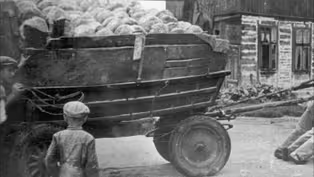
Clip: S3 Ep5 | 2m 31s | Frank Gehry uncovers his family's past on Finding Your Roots: Season Three. (2m 31s)
Video has Closed Captions
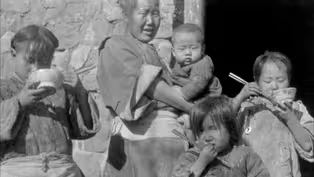
Clip: S3 Ep5 | 1m 24s | Maya Lin explores her heritage on Finding Your Roots. (1m 24s)
Video has Closed Captions
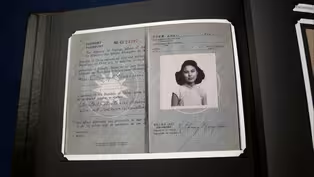
Clip: S3 Ep5 | 1m 48s | See Maya Lin on Finding Your Roots with Henry Louis Gates, Jr. (1m 48s)
Providing Support for PBS.org
Learn Moreabout PBS online sponsorship
- History
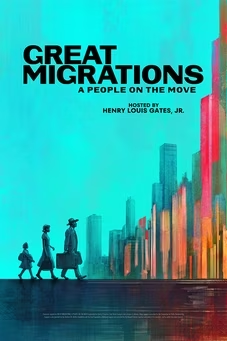
Great Migrations: A People on The Move
Great Migrations explores how a series of Black migrations have shaped America.


Support for PBS provided by:
Corporate support for Season 11 of FINDING YOUR ROOTS WITH HENRY LOUIS GATES, JR. is provided by Gilead Sciences, Inc., Ancestry® and Johnson & Johnson. Major support is provided by...