
In Search of Freedom
Learn about the ancestors of Maya Rudolph, Shonda Rhimes and Keenen Ivory Wayans.
From
Finding Your Roots
In Search of Freedom
Season 3 Episode 3 | 52m 40sVideo has Closed Captions
Learn about the ancestors of Maya Rudolph, Shonda Rhimes and Keenen Ivory Wayans.
Learn how the ancestors of Maya Rudolph, Shonda Rhimes and Keenen Ivory Wayans struggled for freedom, and how each of these cultural trailblazers gain a new understanding of how they fit into this proud trajectory.
From
Problems playing video? | Closed Captioning Feedback
Problems playing video? | Closed Captioning Feedback
Corporate support for Season 11 of FINDING YOUR ROOTS WITH HENRY LOUIS GATES, JR. is provided by Gilead Sciences, Inc., Ancestry® and Johnson & Johnson. Major support is provided by...
Support provided by:


Finding Your Roots
In Search of Freedom
Season 3 Episode 3 | 52m 40sVideo has Closed Captions
Learn how the ancestors of Maya Rudolph, Shonda Rhimes and Keenen Ivory Wayans struggled for freedom, and how each of these cultural trailblazers gain a new understanding of how they fit into this proud trajectory.
From
Problems playing video? | Closed Captioning Feedback
Where to Watch Finding Your Roots
Finding Your Roots is available to stream on pbs.org and the PBS app.
Buy Now
Explore More Finding Your Roots
A new season of Finding Your Roots is premiering January 7th! Stream now past episodes and tune in to PBS on Tuesdays at 8/7 for all-new episodes as renowned scholar Dr. Henry Louis Gates, Jr. guides influential guests into their roots, uncovering deep secrets, hidden identities and lost ancestors.Providing Support for PBS.org
Learn Moreabout PBS online sponsorshipI'm Henry Louis Gates Jr.
Welcome to "Finding Your Roots."
In this episode, we'll explore the family trees of three television superstars: Actor Maya Rudolph, Writer and Producer Shonda Rhimes, and Director Keenen Ivory Wayans.
Three people who have changed the face of entertainment while knowing virtually nothing about their ancestors.
I always think of like all of the little things that would've had to align to get from there to here is incredible.
I wanna know how and why and what happened.
I'm always searching to feel like I fit into something.
I really wanna know my ancestors.
Yeah.
'Cause if they didn't make it, none of us would've made it.
To uncover their roots, we've used every tool available.
Genealogists helped stitch together the past using the paper trails their family left behind.
While geneticists utilized the latest advances in DNA analysis to reveal secrets hundreds of years old.
Maya Rudolph?
Ooh-hoo-hoo.
This is your book of life.
This is- And we've compiled everything into a book of life, a record of all of our discoveries.
Oh my God.
Wow, okay.
That's, I don't know where you got this.
I feel like I don't know anything.
This is insane.
Together, the family stories of Maya, Shonda, and Keenen showed just how profoundly our lives are shaped by the struggles of ancestors we never knew we had.
My guests' ancestors overcame seemingly insurmountable odds to lay the groundwork for their success.
For over a decade, Maya Rudolph has captivated America with her distinct comedic style.
A unique blend of precise character studies and colorful improvisations.
I've been a fan since she first joined the cast of "Saturday Night Live" in the year 2000.
It was clear from the start that she was stunningly talented.
And I wasn't at all surprised to learn that that talent came from her parents.
Maya's mother is Singer and Songwriter Minnie Riperton.
Her father is Composer/Producer Richard James Rudolph.
The two were a dynamic team, cranking out a series of hit records in the mid 1970s and raising Maya in a household filled with as much creativity as love.
I was just always a goof.
My brother always played sports and I'd be like on the sidelines of his baseball games doing dances and singing songs and doing shows in my living room for my parents.
Just great childhood, just like, just the best.
Tragically, Maya's idyllic childhood was shattered when her mother died of breast cancer in 1979.
Maya was just six years old at the time, and in many ways, she's still grappling with the loss.
I think about her, just like proud, proud, loving, loving mother.
You know, I'd see her on stage all the time, this beautiful woman.
She just had her own spirit, her own style, her own essence.
Maya told me that after her mother's death, she became acutely aware of her mixed race heritage.
I mean, growing up, and especially growing up without my mom, I started feeling like an other, you know?
I think you start to realize your hair doesn't look like the hair on the heads of the girls in your classroom, you know, 'cause I went to school with mostly white kids, Jewish and white kids.
So do you think you used comedy to fit in because you were different?
Yeah, 100%, like, if you can't beat 'em, join them kinda thing.
Like, I may not have long golden locks, but I will make you laugh until you love me.
In time, Maya was able to make just about everyone laugh.
And she used her mixed race ancestry to her advantage.
Over her career, she's portrayed a remarkably diverse array of characters, both Black and white.
Despite the fact that Maya is extraordinarily gifted at recreating such a wide range of characters, she knows very little about either side of her family tree.
I have this thing where I just feel like I can be anyone.
Mm-hmm.
But I think being mixed too, I kind of sorta grew up feeling a little orphaned by the idea of my heritage.
I know I'm from peoples, but I don't know who they are.
I wanna know people's names.
I wanna know what they did.
I wanna know where they lived.
I wanna go back as far as possible.
Well, I think you've come to the right place at the right time.
Writer, Producer and Director Shonda Rhimes is the creative genius behind some of the most popular television shows of the past decade.
Since her 2005 debut hit "Grey's Anatomy," Shonda has challenged industry standards by boldly casting lead actors of different ethnic backgrounds.
Along the way, she's garnered millions of viewers, using diversity to change the face of American television.
I think who audiences are and what they're made up of is changing, you know?
We're not an all-white population.
You know, we're not even a 50% white population anymore, but, I mean, it was fascinating.
I remember the first round of casting happening and me looking at my casting director and saying, "How come all the actors are white?"
Uh-huh.
And from that moment on, we sort of changed that rule.
Like if we say all ethnicities, you better send everybody.
Shonda's worldview was largely shaped by her childhood in what has come to be known as University Park, Illinois, a planned community with a focus on integration.
Her parents, Vera and Ilee Rhimes, moved there to escape the racism of the American South.
They raised their six children to believe in a future with no limits, a notion that went unchallenged until it was time for Shonda to apply to college.
I went to sit down with the counselor and I said, you know, "Here are all the schools that I want to apply to."
And she said, "Honey, I don't think that you're gonna get to go to any of those schools."
Mm.
And she said it very, you know, sort of, "Your people aren't, you know, going to these schools."
And luckily, I had been raised by my parents.
And so I sort of said, "Hold on."
You know, it was a given growing up for us that we were going to college.
It was what was going to happen.
Shonda's confidence was well placed.
She went on to graduate from Dartmouth College, then USC Film School before pursuing her dreams in Hollywood where today she dominates primetime Thursday night television, despite being one of the very few Black producers in the business.
So what does being African American mean to you?
There's a rich history there.
It's just, for me and my family, it feels like we're part of a small tribe.
Mm-hmm.
But for all the support that Shonda's family has given her, she told me that many questions remain about her ancestors.
Whole branches of her family tree were never discussed in her home.
Now, when you were growing up, did your family ever talk about slavery?
The experience of slavery in your line of people?
No, but as somebody who fills in every creative nook and cranny in my head, it's fascinating.
You always wonder what their lives were like, who they were owned by.
I mean, you always wonder that stuff.
Where- My third guest is the multi-talented Comedian Keenen Ivory Wayans.
Keenen changed television in 1990 with the launch of "In Living Color," which he wrote, produced, and in which he starred.
This breakthrough series with a predominantly Black cast that spoke directly to a rising multiracial hip-hop generation, offered something completely new.
The show was huge and it was funny and used comedy to explore race in a way that I at least had never seen before.
We were doing our version of "Saturday Night Live" and it really kinda shook up TV for that time.
Mm-hmm.
and we became like these bridges in America you know, between white suburban kids and urban kids.
Mm-hmm.
And we went for it.
"In Living Color" helped jumpstart an impressive career.
With almost 20 films and TV series under his belt, Keenen has been a dominant presence in Hollywood for over two decades.
But looking back, he doesn't credit his success to this innovative series.
Instead, he thinks it comes from something much deeper.
What do you think drove your success?
Oh, family.
My family was my motivation: getting them out the projects.
That was it.
Growing up for us was very challenging, because we were a large family, a very poor family.
Even though we grew up in a poor neighborhood, we were the poorest of the poor.
So we were kind of outcasts to begin with, you know?
And so we kind of rallied around each other.
Born in New York City in 1958, Keenen was the second of 10 children.
He grew up in the Robert Fulton housing projects inhabited by Irish, Puerto Rican, and African American families.
A racially diverse environment that would prove to be the ultimate training ground for his comedy.
The teenagers on the corner, they would hang out on the corner, the white kids, and every time I go to store, they would call me nigger.
Mm-hmm.
So I came up and I was upset and I told my mother.
My mother said, "Baby, you go back down there and if they call you nigger again, you tell 'em to call you Mr.
Nigger."
So I was like, "Hey, yeah, that's... All right," so I walked past them on purpose and the guy goes, "I thought I told you to get outta here, li'l nigger."
I turned to him and say, "Hey, man.
You don't call me nigger, you better call me Mr.
Nigger."
They went on for 15 minutes calling me Mr.
Nigger, Mr.
Coon, Mr.
... Mr.
every derogatory Black name they could come up with.
And I was just like, "Uh, that didn't work."
So you went to the acting school- School of life.
Of the Wayans.
That's right.
That's Right.
Keenen, like Maya and Shonda, sees himself as a product of the world in which he grew up and of the parents and siblings who surrounded him in that world.
Yet like so many Americans, Keenen, Maya, and Shonda know very little about the ancestors who fill the branches of their family trees.
It was time to meet those ancestors and to see how their stories shaped the lives of my guests.
Maya Rudolph's mixed background has profoundly affected her, yet growing up, she heard very little about either her African American or her Jewish roots.
To reconnect her to her lost heritage, we started with the ancestry of her father, Richard James Rudolph, who raised Maya and her brother on his own after their mother's death.
My dad just sees the silver lining in everything and figures it all out and has tried to motivate me in that direction my entire life because I get really mad about the unfairness of life.
And my dad is just this beautiful spirit that just figured out how to look at things in a more positive way.
Maya's father was born in 1946 and raised in Pittsburgh, Pennsylvania.
His parents, Muriel Eileen Neufeld and Sidney Rudolph were of European Jewish descent, but both had lost touch with their religion and their roots.
Were you raised in a religion?
No, my dad was not raised with religion, because my grandfather, Sid Rudolph, did not believe in organized religion.
He didn't like being told what to do.
Mm-hmm, did your grandparents tell family stories?
No, I only know about Julius Rudolph, my great-grandfather, who was a haberdasher.
Mm-hmm.
Maya told me that she thought the Rudolphs may have come from Russia or Poland, but she didn't know for certain.
I wanted to find out.
We found our first clue in a ship's manifest for the SS August Victoria, which arrived in New York City in 1902.
Now, Maya, this is very cool.
Oh my God, Judel Rudashevsky?
That's right.
Judel Rudashevsky.
Judel?
Mm-hmm.
Age 21.
Judel Rudashevsky became Julius Rudolph.
Oh, that's Julius?
Yeah.
Aw.
That's his real name, his original name.
Judel?
Wow.
Now, if you look closely at that record, he was only 21 years old at the time.
Wow.
He was by himself?
Yep.
He was totally by himself.
It's gotta be terribly lonely.
Maya was eager to know where Julius had come from, but the manifest didn't say.
We needed more information.
We found it in Julius's application for American citizenship, filed in 1913.
In it, Maya's great-grandfather listed his birthplace, Vilna, then a city in the Russian Empire, now the capital of Lithuania.
"I was born on the 7th day of May in 1882 at Vilna, Russia."
You are Lithuanian.
What?
During Julius's life, Vilna was considered something of a Jewish cultural center within what was known as the Pale of Settlement, the vast area created by the Russian Empress Catherine the Great in 1791.
The majority of Russian Jews were forced to live and work here.
By the time Julius was born in 1882, roughly four million Jews lived in the Pale, accounting for nearly 40% of the world's Jewish population.
Although the ravages of two World Wars have destroyed many vital records in the region, we got lucky.
We found a Rudashevsky family birth record in the Lithuanian state archives and were able to retrace several generations of Maya's ancestors.
Your fourth great-grandfather, Abram Rudashevsky, was born around 1799.
Wow.
Abram Rudashevsky, head of the family, son of Vulf?
Vulf.
Vulf?
Yeah.
Another generation on your family.
Come on.
You just met your fifth great-grandfather, Vulf.
Are you serious?
That's incredible.
Vulf?
Hi, Vulf.
Maya has deep roots in Vilna's Jewish community, and when her family came to America, they brought their traditions with them.
Julius didn't have it easy when he came, so we couldn't believe it.
Just three years after becoming a citizen of the United States, your great-grandfather was one of the founding members of congregation Beth Shalom in Pittsburgh.
Oh my God.
It's a conservative Jewish synagogue and today it has close to 650 congregant families.
Did you have any idea that Julius helped to found one of the largest synagogues in Pittsburgh?
No, why wasn't I bat mitzvahed?
Well, but you have deep, deep Jewish roots by name.
Which I do find hilarious because look at my grandfather, Sid Rudolph.
He obviously was trying to come up with his own thing and stand apart from his family because they were so religious.
Mm-hmm.
I mean, that's - Big time.
Shocking to me.
Mm, I mean, count all those generations and you're back to 1773.
Vulf.
Vulf.
I love it.
Like me, I'm connected to that?
It's amazing.
For somebody who feels kind of rootless... Mm-hmm.
Not anymore.
Like Maya, Shonda Rhimes grew up knowing little about her ancestry beyond her immediate family.
Raised in Illinois by transplanted Southerners, she was eager to connect with her lost Southern heritage.
We began our search on her father's side.
Your father, Ilee Rhimes Jr.
was born June 4th, 1942 in Colt, Arkansas.
When you were growing up, did he talk to you and your sibs much about his roots?
He told us some stories, but not much.
But I feel like I grew up in a very Southern-feeling household.
It's funny because I feel like that's where really the spirit of my family is.
It turns out Shonda's father's roots spread all over the Deep South and illuminate many crucial elements of the African American experience.
In 1949, when he was seven years old, Ilee Rhimes moved from Arkansas to Chicago with his divorced mother, a woman named Mabel Love.
They were searching for a better life and they found it, but they left a wealth of family stories behind.
One of the most remarkable involves how the family ended up in Arkansas in the first place.
In the 1910 Census, we found Shonda's great-grandparents, James and Rosa Lee Love, living on rented farmland in Sunflower County, Mississippi.
Their existence was precarious at best.
You ever hear of this place, Sunflower County?
No.
Well, Sunflower County is located in the middle of the Mississippi Delta.
It was known for two things, poverty and segregation.
There you go.
Can you imagine what life was like for your ancestors?
They're renting their house and they're working as farmers, most likely on a cotton farm.
That must have been brutal.
Can't even imagine.
The family lore claimed life was so terrible for Shonda's great-grandparents, they had no choice but to escape from Mississippi with their young family.
A risky endeavor as white landowners were to prevent their Black tenant farmers and sharecroppers from leaving.
So one night, your great-grandparents sneaked out of Sunflower County under the cover of darkness and moved to Arkansas.
Wow.
You ever hear that story?
No, that's so interesting.
Can you imagine living someplace that you have to- It's so bad that you have to pack up in the middle of the night and run away from?
Right.
No.
Or face retribution if you even thought about moving.
I mean, you might as well have been a slave.
Shonda's ancestors were taking a tremendous gamble.
They left Mississippi with nothing, but they were willing to work hard and their gamble paid off.
We unearthed a land deed from 1918 for property owned by James Love.
Remarkably, in just eight years, Shonda's great-grandfather had managed to save $900 to buy a plot of land and give his young family a fresh start.
Jimmie Love, he got his 40 acres.
He got his 40 acres.
And by the way, $900 in 1918 would equal roughly $14,000 in today's money.
That's pretty successful.
To escape in the middle of the night with his family, to find some place for everybody to live, to save $900, and then buy 40 acres of land is astounding.
Yeah, and Jimmie Love owned this land for the rest of his life.
Wow, he sort of set him himself up and his children up for a lot more success than most people ever had a chance at, didn't he?
I feel like this piece of history is really powerful, but the idea that I didn't even know the story.
It's quite remarkable.
Yeah.
I wanna know how and why and what happened.
Mm-hmm.
You know what I mean?
That person, the one who stole away in the middle of the night, you wanna know who that is.
Like Shonda, Keenen Ivory Wayans was raised in a Northern city, but his roots stretched back to the Rural South.
To unearth those roots, we started with his mother, Elvira Green.
Would you please turn the page?
Ah, who's that beautiful woman?
That's my mom.
She is gorgeous.
I was the kind of kid that whatever she asked me to do, I would do.
Sure.
You said that your mother instilled self-confidence, pride, and self-worth in you and your siblings.
Yeah, my mother taught us to always challenge the ideas of the day.
So that kind of stuff stays in your head and teaches you to think a certain way.
Mm-hmm.
I remember when I was a little boy, my mother got tickets to Leonard Bernstein, but she couldn't go, 'cause she couldn't afford a babysitter.
So she gave me the tickets and she said, "You may not understand this, but mama wants you to go."
And so she dressed me as best, you know, I could.
I had on a plaid shirt and some corduroy pants, and I'm sitting there, you know, Leonard Bernstein, everybody else got on tuxedos.
You know, but she just wanted me to have that experience.
Elvira was raised in Harlem, and its cultural scene was an inextricable part of her childhood.
But when we followed her family line back one generation, we entered a very different world.
Elvira's father, Keenen's maternal grandfather, was Ivory Garrett Green.
He had deep roots in Rural Clarendon where Keenen's ancestors worked for decades, first as slaves, then as farmers on rented land.
We were able to trace Keenen's family in Clarendon County as far back as his great-great-grandfather, Marion Brock, who was born around 1840 and who almost certainly was born into slavery.
Many African Americans are never able to identify even one generation of their enslaved ancestors by name, but we were able to take Keenen back even further.
Marion Brock's death certificate revealed his mother's name, Milly Martin.
And because slaves sometimes took their slave owners' names, we began to search for white men named Brock or Martin, who might have owned Milly and Marion.
So let's see what we found.
Now, Keenen, this is a page from the estate record of a man named Francis E. Martin.
So it's an inventory of all of his possessions.
Bill of appraisement of goods and chattels.
Wow.
Okay, Milly, $600, Abraham, $200, Moses, 125, and Marion, $75.
The whole family.
That's right.
Milly and Marion, they're both there.
Your third great-grandmother would have been about 24 years old.
Her son, Marion, your second great-grandfather was just a baby.
This is powerful.
This is not like one slave.
This is a whole family.
Mm-hmm.
It's like this family's kept together, you know what I'm saying?
Right.
Wow.
So this is 19 years before the Civil War.
We know that your family was enslaved.
We know their names.
We know what they were worth, and we know who owned them and on what plantation they lived.
Yeah, you know, as a contemporary African American, it's almost a little frightening, you know, because this isn't that long ago.
Mm-hmm.
and it's just proof of how far we have come.
Keenen was surprised to see that his family had managed to stay together despite slavery.
He was even more surprised to learn what they were able to accomplish after emancipation.
During Reconstruction, when most former slaves were struggling sharecroppers, an 1872 land deed signed by Marion Brock revealed that he not only bought his own land, but a good amount of land, 105 acres.
Signed, sealed, and delivered by his mark, Marion Brock.
Right there, that X. Wow.
And it means that although he couldn't read and write, your great-great-grandfather Yeah.
Just seven years after emancipation.
Wow.
And, Keenen, we learned that your ancestor, Marion Brock, purchased an additional 95 acres 10 years later.
Wow.
That's 200 acres.
Yeah.
Your second great-grandfather was a mogul.
He was like the Donald Trump of the Black people.
Well, this is amazing.
I did know that my mom's side of the family, that they were a very industrious group, but, wow.
Ain't that cool?
That's incredible.
I'd already introduced Maya to a long line of Jewish ancestors on her father's side.
Now it was time to turn to her African American heritage, a heritage with which she's been longing to reconnect ever since her mother's early death.
To begin, we traced her maternal line back to the marriage certificate of her great-grandparents, Molly Grigsby and George Riperton.
Ooh, I like this.
Molly and George were married in Lincoln County, Kentucky on October 28th, 1897.
What's it like to see that, that thing survived?
This is incredible.
This is beautiful.
Wow.
This marriage certificate helped us trace George Riperton's family back to Maya's third great-grandparents, John and Lucinda Meaux.
They were born into slavery in Mercer County, Kentucky around the turn of the 19th century, and they have a remarkable story.
In the Mercer County Court Records, we found a will written in 1826.
It revealed that 37 years before the Emancipation Proclamation, the man who owned Maya's ancestors made the very unusual decision to free all 61 of his slaves upon his death, and to give them practically everything he owned, including his tools, the crops, and all of the livestock.
Two of those 61 slaves were your third great-grandparents, John and Lucinda.
Wow.
Why did he do that?
Well, he seems to have done so for genuinely moral reasons.
Amazing.
Amazing, amazing.
I mean, it's really beautiful to see something like that in writing.
Unfortunately for Maya's ancestors, having your freedom written into a will was no guarantee you would be treated as a free person.
Court records from the 1830s show that John Meaux's family exploited his former slaves long after his death, working them without paying them, ignoring contracts they made with him, and essentially daring the former slaves to sue their former master's family for what was rightfully theirs.
Would you please read the transcribed section?
I frequently heard the Negroes complain about being kept under Meaux and that they ought to have their freedom.
It's a shocking story, but Maya's ancestors were not about to be intimidated.
They challenged John Meaux's grandson in a court of law.
And when?
Well, your third great-grandfather was awarded 100 acres of land.
Wow.
Your ancestor had the courage to stand up for himself and his family.
It goes, he sued a white man in a slave state, Kentucky, and he won.
How was that even possible?
Yeah.
Pretty rare, but he did it.
Oh, that's just unbelievable.
And he had to have white people testify for him.
I can't imagine what the odds could have been, and then they went in his favor.
To me, that's tremendous courage.
That's wild.
Yeah.
Yeah, they're my people.
Mm-hmm.
It's really cool.
Maya understood that we've been lucky to identify even one of her enslaved ancestors by name, but this was only the beginning.
When we turned to another of Maya's maternal lines, the Grigsby family line, we were able to trace it back to Manuel and Mary Grigsby, both of whom were born into slavery in Lincoln County, Kentucky in the years around 1830.
Attempting to find out more about their lives, we searched for any white slave owners with the surname Grigsby who lived in the area.
So it's a real long shot and in the whole county, guess what?
Nothing.
One family.
No.
Could you please turn the page?
Yes.
This is the 1860 Slave Census for a man named John Warren Grigsby.
Oh my God, oh my God, oh my God, my God.
Cannot believe I'm looking at this.
The census showed that Grigsby owned 32 slaves, identified only by age and gender, never by name.
And so we began searching for traces of Maya's ancestors, looking for a boy who would have been roughly five years old and his mother and father who would have been in their 30s.
Now, you see, look closely at those hash marks.
Remember, James, he would have been about five.
Can you find anyone who could have been the same age?
Oh, five, that breaks my heart.
Wow.
I just think of my kids.
So it's really hard to see.
Wow, five years old.
Mm.
Yeah, wow.
I just can't believe what I'm looking at.
Oh my God.
You're looking at your family- With their baby.
You're looking at two generations of your family tree who were owned by that man, Warren Grigsby.
That poor little boy, Jesus.
It's insane.
Wow, just when I understood what the numbers were that I'm looking at, that's what broke my heart, wow.
You just don't think of details because you don't have them.
So you can't, you know, think of... And then I see five and I think of my daughter.
Uh-huh, mm.
And to think that you'd have no prospect of being free.
I just can't imagine.
How can you?
How can you imagine anything like that?
Can you believe that we were able to trace your family back this far?
I had no idea.
I mean, here, you descended from one ancestor who shows up from Russia, really, Lithuania today, not reading any English, right, or writing English.
And on your mom's side, the oldest ancestor we identified was John Black Meaux, born 1797 in Kentucky.
Wow.
I mean, most Black people can't even name the names of their enslaved ancestors, but you just meant yours.
I can't even believe that.
But this strange connection that it gives me, you know, it just makes you feel like you're part of something so much bigger.
We had already introduced Shonda Rhimes to her paternal great-grandfather, James Love, who escaped with his young family from in the early 20th century.
We were now ready to take this family further back in time.
The 1900 census shows James Love as a teenager, living with a couple named Anna Watson and Burrell Love.
They are almost certainly James's parents and Shonda's great-great-grandparents.
And this led us to a powerful discovery.
The census tells us that Burrell and Anna were each born in Mississippi over a decade before the end of the Civil War.
Okay.
So they were slaves.
They were slaves.
You've just met your great-great-grandparents.
Wow, it's fascinating to think about what their lives must have been like and who they must have been.
That's incredible.
To help retrieve those details, we turn to the 1870 Census, the first taken after the end of the Civil War, and the first time that all Black people were listed by name in a federal census.
It gave us invaluable details about the woman who is most likely Shonda's great-great-grandmother, Anna Watson, including the name of her mother.
Matilda Watson, Black, age 55.
Occupation, keeping house.
Annie Watson, Black, age 17.
That 17-year-old is most likely your great-great-grandmother, Anna Watson.
And Anna is living with her mother, 55-year-old Matilda Watson.
She would be my great-great-grandmother, great-great-great-grandmother.
Great-great-great grandmother.
As you can see, Annie's father is not living in this household.
In fact, we never found a record listing Annie with her father.
Now, remember, Annie was born as a slave in the 1850s, right?
So it's possible that the family had been split up.
Right.
Wow.
To find out more, we searched through the records of Monroe County, Mississippi, and soon focused on the 1850 and 1860 slave schedules for two brothers, Asa and Rufus Watson.
These listings of nameless enslaved men, women, and children, identified only by age and gender, contained our best hopes for learning about the lives of Shonda's ancestors.
Would you please turn the page?
I'm scared.
Do you see possible matches for Annie and Matilda?
Yes, eight-year-old female, 38-year-old female, yeah.
That could be your great-great-great-grandmother, Matilda, and an eight-year-old girl, which is a match for your great-great-grandmother, Annie.
Wow.
I'm a little bit speechless.
I didn't think we were gonna go back into slavery at all.
Mm-hmm.
I mean, right now, this feels unimaginable.
Like I sit here and I think what this must have been like and I can make things up in my head, but I can't actually imagine what it would be like to not even have a name, to not even be important enough to have been assigned a name.
Mm-hmm.
Yeah.
Yeah.
What's even stranger is that, and this is crazy, but for my entire childhood, Matilda was the name I was gonna name my child.
No.
Yeah.
So I kinda can't believe it.
That's amazing.
I know.
It feels very circular universe or something.
I don't know.
As we piece together this chronology, your family's search for better life is coming into focus, right?.
Shonda, to point out how much ground we've covered so far, Matilda was born 200 years ago, and then her descendant, James Love, was born in Mississippi in the 1880s.
It's a remarkable story from 1880 to you.
Yeah, from living in the most segregated, scary, you know, living in Sunflower County to now, to Los Angeles, is insane and something to be kind of proud of.
And I always think of like all of the little things that would've had to align to get from there to here is incredible.
We journeyed up one branch of Keenen's family tree to find the story of a newly freed slave who laid the foundations for future generations of Keenen's family.
Now, we would tell Keenen a very different kind of story.
Following his maternal grandmother, Elvira Brown's line, we went back several generations to Keenen's great-great-great-grandfather, a man named Ben Pleasant, who was born into slavery around 1826.
We found Ben's obituary published after It revealed that Ben had once been the enslaved personal servant of a man named John Manning, the governor of South Carolina.
Could you please turn the page?
Wow.
He looks exactly the way you would expect him to look.
Yeah.
Exactly.
Wow.
This is Ben Pleasant.
That is your third great-grandfather, Ben Pleasant.
Wow.
That photograph was taken right after emancipation, Keenen.
God.
Very few Black people have a photograph of their third great-grandfather.
This is priceless.
Mm.
Now, can you believe that your third great-grandfather, Ben Pleasant, was Manning's slave and private valet?
Keenen's ancestor served an extremely powerful man.
John Manning was not only the governor of South Carolina from 1852 to 1854, he was also one of the wealthiest men in the state.
He owned over 600 slaves across two plantations.
During the Civil War, he fought for the Confederacy, and even the South's defeat didn't diminish his power.
After the war, he was elected to the United States Senate, but he was not seated because he refused to take the oath of allegiance to the North- To the Union.
To the Union.
Yes.
So this Manning man was hardcore.
Totally hardcore.
Now take a look at this.
That's Governor Manning and that's his plantation house.
Wow.
He looks like he owned 600 slaves.
Wow, look at that house.
In our search to find out more about Ben's life as Governor Manning's servant, we came across an account of a trip the governor took to Canada in the early 1840s.
As we might expect, he took Ben along, but events north of the border took a very strange turn.
And we came across a pretty amazing story.
You ready?
Ready.
Would you please read the highlighted section?
"While in Canada, some zealous abolitionists kidnapped Ben and secreted him until Governor Manning had ceased to make search and had started back home."
What's this, man, your ancestor was kidnapped by abolitionists in Canada.
Can you believe that?
Yeah.
He was taken.
He was actually taken out of slavery.
Taken out of slavery.
And you're gonna tell me he went back?
Would you please turn the page?
Wow, wow, oh my God.
In another article published in 1903, we found an account of Ben's willing return to bondage, recounted in what are purported to be Ben's own words.
"We went across the river into Canada, but it proved to me that it was a mistake.
In spite of many inducements held out to me to stay in Canada, the love of home and of those at home and my contentment with my condition seemed to blind me to all the rest of the world.
So I just picked myself up and at last found my old master, and that was a happy meeting, I'm telling you."
Wow, this is crazy.
You know, when you hear... When you hear about your family in slavery, the story you wanna hear is that your great-grandfather was Kunta Kinte, that he cut off his foot and ran away, led all the other slaves to freedom.
My story is he went back, so it's like, what?
Wow.
Yeah.
And do you know what?
He stayed on at the Milford Plantation as a caretaker even after he was emancipated and even after John Manning died in 1889.
Wow.
So he felt deep ties to it.
Would you have made the same decision?
Well, I don't know if I would've made that same decision, but I understand the decision that he made.
All I could think about was my family and my kids and, you know, would it be worth it?
You know, that's not freedom, to leave them behind.
That's not freedom.
That's anguish.
Right.
It changes the way I think about all history.
I could never see myself before, but this information really allows me to know who I am, 'cause if they didn't make it, none of us would've made it.
We'd reached the end of the paper trail for Keenen, Maya, and Shonda.
Now, advances in genetic genealogy allow us to look even more deeply into the past.
My guests agreed to take DNA tests that would shed light on a part of their ancestry, once inaccessible to African Americans, the origin of their African ancestors.
Shonda Rhimes was thrilled at her results.
This is your Africa moment.
Wow.
That's amazing.
47% Nigerian.
10% Benin Togo, 8% Africa Southeastern Bantu, 8% Ivory Coast/Ghana.
Yeah, and three of those makes sense 'cause the majority of the enslaved Africans brought to the Americas would've been from those areas.
That's so amazing that you can just pinpoint it.
Isn't that astonishing?
Yeah.
Before we turn to Maya's African origins, we first wanted to help clear up a lingering question in her family.
Like many people of African American descent, Maya had grown up hearing that she had Native American ancestors.
I remember my grandfather's funeral, it was an open casket and I saw my grandfather there and everyone said, "You can see it in his nose."
Oh yeah, look at that.
He was part Native American.
Well, Maya Rudolph, would you please turn the page?
Okay.
I knew it.
I didn't know it.
Today, I felt like, "Oh, he's gonna say yes."
Zero.
Zero.
Zero Native American.
If your great-grandmother, Molly, was a full Native American ancestry, some of that would've been passed down to you, but since you have no Native DNA, Molly couldn't have been Native American.
Are you disappointed?
Yes.
With this question answered, we turn to the question of Maya's African heritage.
We were quite shocked by what her DNA disclosed.
Maya showed a Southeast Asian component, quite unusual for an African American, which led us to trace her roots to a most exotic place.
So we did a little more digging and we found something surprising.
Would you please turn the page?
Yeah.
Madagascar?
Madagascar.
What?
Mm-hmm.
Scientists believe that thousands of years ago, people from what we now consider to be Indonesia canoed across the Indian Ocean to populate the island of Madagascar, bringing DNA from Southeast Asia to the African continent.
A tiny amount of this DNA ended up in America due to the slave trade.
In the late 18th and early 19th centuries, Madagascar was a pirate stronghold and its pirates were occasionally involved As a result, there are 17 ships known to have sailed from Madagascar to what became the United States, carrying roughly 6,000 slaves in total.
One of them was Maya's ancestor.
Think about how long that boat trip took.
You had to go all the way around the Cape of Good Hope and then cross the Atlantic.
Mm.
And you're a descendant from one of 'em, and that's why you see that unusual result in your admixture in your DNA.
Huh?
This is not what I expected.
Less than 2% of all the slaves brought to North America originated in Madagascar, so Southeast Asian DNA is extremely rare among African Americans, which is why we were surprised when we looked at Keenen's results.
Where do you see matches?
There's not a single speck of color on this map in the entire continent of Africa, so it means that your paternal haplogroup was not from Africa and it's not from Europe.
Where is it found?
Asia.
Asia.
Mostly Southeast Asia.
Wow.
That is your deep genetic history that on your male side, you go all the way back to Indonesia, but thousands and thousands and thousands of years ago.
And 300 years ago, you go back to Madagascar.
That's your Kunta Kinte.
Yes.
Came from Madagascar.
Wow, you know, you have these ideas about who you are, right?
And when you find out things like this, you know, I'm a Black man and I'm Chinese.
It's like what happened?
That's the end of our journey through the family trees of Maya Rudolph, Shonda Rhimes, and Keenen Ivory Wayans.
Join me next time when we unlock the secrets of the past for three new guests on another episode of "Finding Your Roots."
(music plays throughout credits)
In Search of Freedom Preview: Keenen Ivory Wayans
Video has Closed Captions
Clip: S3 Ep3 | 1m 39s | Keenen Ivory Wayans explores his family history in Finding Your Roots: Season Three. (1m 39s)
In Search of Freedom Preview: Maya Rudolph
Video has Closed Captions
Clip: S3 Ep3 | 1m 20s | See Maya Rudolph in episode three of Finding Your Roots: Season Three. (1m 20s)
In Search of Freedom Preview: Shonda Rhimes
Video has Closed Captions
Clip: S3 Ep3 | 1m 9s | Watch Shonda Rhimes in episode three of Finding Your Roots: Season Three. (1m 9s)
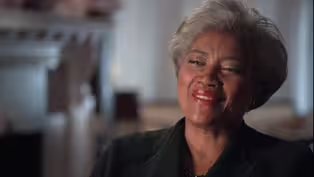
Finding Your Roots: Season Three Preview: Donna Brazile
Video has Closed Captions
Clip: S3 Ep3 | 2m 56s | Watch a clip of Finding Your Roots, episode one, with guest Donna Brazile. (2m 56s)
Providing Support for PBS.org
Learn Moreabout PBS online sponsorship
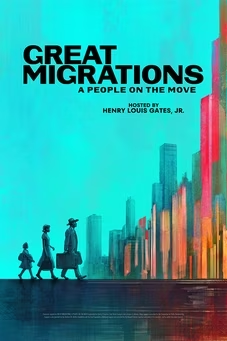
- History
Great Migrations: A People on The Move
Great Migrations explores how a series of Black migrations have shaped America.


Support for PBS provided by:
Corporate support for Season 11 of FINDING YOUR ROOTS WITH HENRY LOUIS GATES, JR. is provided by Gilead Sciences, Inc., Ancestry® and Johnson & Johnson. Major support is provided by...